
AI Tools Replacing Business Services: Why 1 in 4 Owners Lost Business

A client who has been with you for years stops sending work. There is no complaint and no cancellation email. A few months later, you find out they are handling it in house with an AI subscription that costs less than one of your invoices.
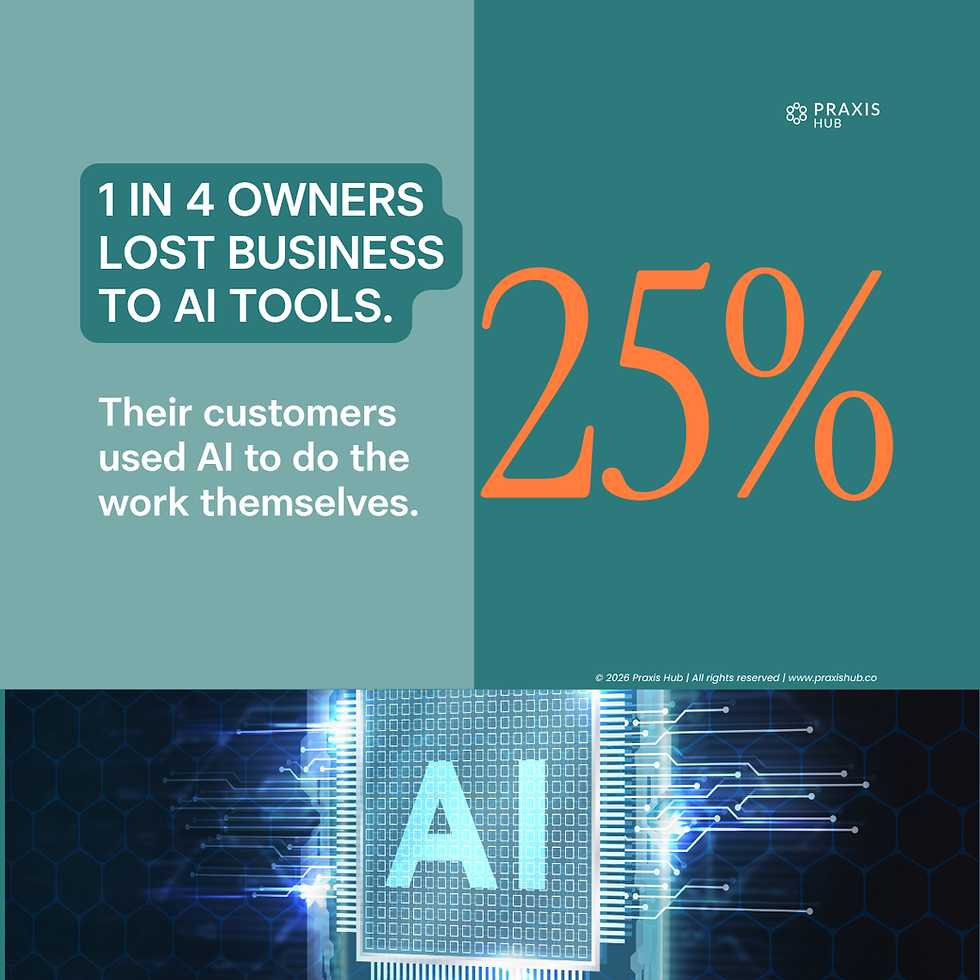
That moment now has a number attached to it. A UPrinting survey of 1,000 U.S. adults, including small business owners, managers, and entrepreneurs, found that 25% of business owners lost business in the prior year because customers used AI tools instead of paying for their service.
What the UPrinting Survey Found
The headline number gets shared. The rest of the data is more useful, because it shows the same technology working on both sides of the ledger.
Only one of the six findings describes a loss: the 25% in the opening. The other five describe where owners see AI helping, what worries them, and where they draw the line. 46% of small business owners said marketing content is where AI could help them most right now. Among small business owners making $150,000 or more, 54% pointed to customer support.
Concern runs alongside the opportunity. Nearly two in three business owners, 65.5%, worry AI will make their business feel less personal or authentic to customers. One in five Gen Z owners are very worried about misinformation driven by AI affecting their customers or their brand. Half of senior managers will not hand hiring or performance decisions to AI.
The survey does not publish subgroup sizes, so the narrower figures deserve lighter weight than the headline. The direction is still plain. The technology owners see helping their marketing and customer support is the same one their customers are using in place of a paid service.
The Cheapest Competitor in the Room
Every service business has always competed with the customer doing it themselves. What changed is the cost of that option. Doing it yourself used to mean watching tutorials. Now it means typing a request and getting a usable draft in seconds. The UPrinting report's own example: people who once searched for how to design a logo now ask an AI tool to generate one.

When a service is bought as a file, the buyer compares files. In that side by side comparison, the lowest price wins. A monthly AI subscription will win that contest almost every time.
The shorthand for this is now everywhere: AI tools replacing business services. Underneath the headline, it is a pricing event before it is a technology event. AI did not create the commodity problem. It showed up as the lowest bidder any service business has ever faced.
Where the Exposure Lives
Nothing in the survey suggests the owners in that 25% are less skilled than anyone else. In my experience across different industries, exposure tracks how the value is packaged and delivered, far more than how good the work is. The services that lose ground first tend to share a few traits.
The client sees the finished output and nothing of the thinking that produced it.
Each project starts from scratch instead of building on what the business already knows about the client.
The expertise lives in one or two people rather than in how the firm operates.
The relationship is a series of transactions with no operating rhythm between them.
The price is quoted per deliverable, which invites comparison per deliverable.
Each of those traits is structural, and none of them is a judgment on the owner. They come from a business that grew by doing excellent work one project at a time. The back office was never designed to carry that knowledge forward. The same gap shows up when businesses adopt AI internally. It is why AI implementation results stall in the back office long before the tool is to blame.
The Proximity Problem
The people who build a service business are usually the last ones able to see it from the outside. They know the judgment calls, the client history, and the shortcuts that make the work good. The client sees an invoice and a file. The distance between those two views is exactly where an AI tool slips in.
That is not a competence gap. It is physics. Anyone standing inside an operation every day loses the outside view of it. The patterns that make a service easy to replace stay invisible because they feel normal to everyone running it.
What a Prompt Cannot Copy
In my experience, the service firms that hold their clients through a shift like this are selling something different. Their value is tied to how the client's business runs. Their delivery depends on a system that carries context, history, and judgment from one engagement to the next. Replacing them would mean rebuilding that system, and no subscription does that.
This is where the back office stops being overhead and becomes protection. Revenue comes from the front office. Cash flow is protected in the back office. When client knowledge, decision paths, and delivery standards live in the business, the firm can show value a prompt cannot imitate. A file can be priced against a subscription. A result tied to the client's operations has no cheap substitute.

The survey's opportunity numbers point the same way. Owners who see AI helping with marketing and customer support are describing the tool working inside their own operation. That works when the operation underneath is organized. When it is not, AI multiplies whatever is already there. AI brings general expertise. It does not bring a business's own context. Building that into how the business runs is the work of back office process improvement.
Free Resource: AI Readiness Assessment
Before spending another dollar on AI, see where the business stands. The AI Readiness Assessment takes about seven minutes and five short questions. It shows your current AI readiness stage, points to the workflows or data that may be holding the business back, and offers simple preparation steps that don't require any tools.

AI Tools Replacing Business Services: Frequently Asked Questions
How many business owners have lost business to AI tools?
A UPrinting survey of 1,000 U.S. adults, conducted through Pollfish and including small business owners, managers, and entrepreneurs, found that 25% of business owners lost business in the prior year because customers used AI tools instead of paying for their service. That is roughly one in four. The survey did not publish subgroup sample sizes or a margin of error.
Which services are most exposed to AI tools?
Services bought as a finished file face the most direct pressure. The buyer can compare that file against what an AI tool produces in seconds. The UPrinting report uses logo design as its example. In my experience, exposure rises when the client sees only the output, and when the expertise lives in one or two people instead of in how the business operates.
Why do some service businesses keep their clients when AI is cheaper?
Their clients are not comparing one file against another. Their value is tied to how the client's business runs, and their delivery carries context and history from one engagement to the next. Replacing them would mean rebuilding a working system, which a subscription cannot do. That switching cost protects the relationship more than price or personality does.
Should small business owners use AI tools themselves?
Many already see the opportunity. In the UPrinting survey, 46% of small business owners said marketing content is where AI could help most right now, and 54% of owners earning $150,000 or more pointed to customer support. AI performs best inside an operation that is already organized. Inside a disorganized one, it tends to multiply the problems that were already there.
How can an owner tell whether the business is ready for AI?
A fast starting point is the AI Readiness Assessment from Praxis Hub, available at praxishub.co/ai-readiness-assessment. It takes about seven minutes and five short questions. It shows the business's current AI readiness stage and points to the workflows or data that may be holding it back.
Ready to Make Your Business Harder to Replace?
If this post described something you have already felt in your own pipeline, a conversation is the right next step. A discovery call is a close look at where your operation carries its value today and where it is exposed.
The Back Office Brief
A weekly insight connecting back office operations to profit. For business owners and leaders who want to stop leaving money in broken systems.


Comments