
Customer Trust Before Service Delivery: Your Customer Is Judging You Before the Work Starts

Say a customer asks a contractor for an estimate on Monday. It arrives Thursday. By then the customer has booked another company for the $18,000 job, and the first contractor never learns why.
The work was never judged. The customer graded something earlier: how the business handled the wait. That grade gets set before a single task begins, and it decides whether the work ever gets a chance.
The Grade Arrives Before the Work
The front office is where a business wins customers: sales, marketing, the first conversation. The back office is where it keeps its word: scheduling, estimates, confirmations, follow-up and billing. Customers judge the front office by what it says. They judge the whole business by what the back office does next.

Harvard Business Review research on how companies handle online customer queries shows that most companies are not responding nearly fast enough. An inquiry is the customer's first request. The response is the business's first answer, and customers can read it as a preview of the work.
That grade seldom reaches a review, because the customer who leaves seldom explains why. They book someone else, and the business records a loss it cannot trace.
Customer Trust Before Service Delivery: What the Wait Costs
Take a contractor who sends 20 estimates a month on jobs that average $12,000. Close one more estimate each month and that is $144,000 a year in added revenue. The extra close does not need better work. It needs a customer who still believes the business will do what it says.
Customers leave little room for error. PwC customer experience research reports that 32% of customers stop doing business with a brand they love after only one bad experience. That figure does not single out late estimates. It does show how quickly a customer's patience can run out.
The cash flow cost reaches past the lost job. In my experience across industries, a customer who waited on the estimate reads the invoice more closely and questions it more often. A questioned invoice is a late invoice, and a late invoice is cash the business earned and cannot spend.
Here is the pattern: customer trust before service delivery is set by small commitments, and cash flow feels it first.
Six Small Misses Customers Read as One Signal
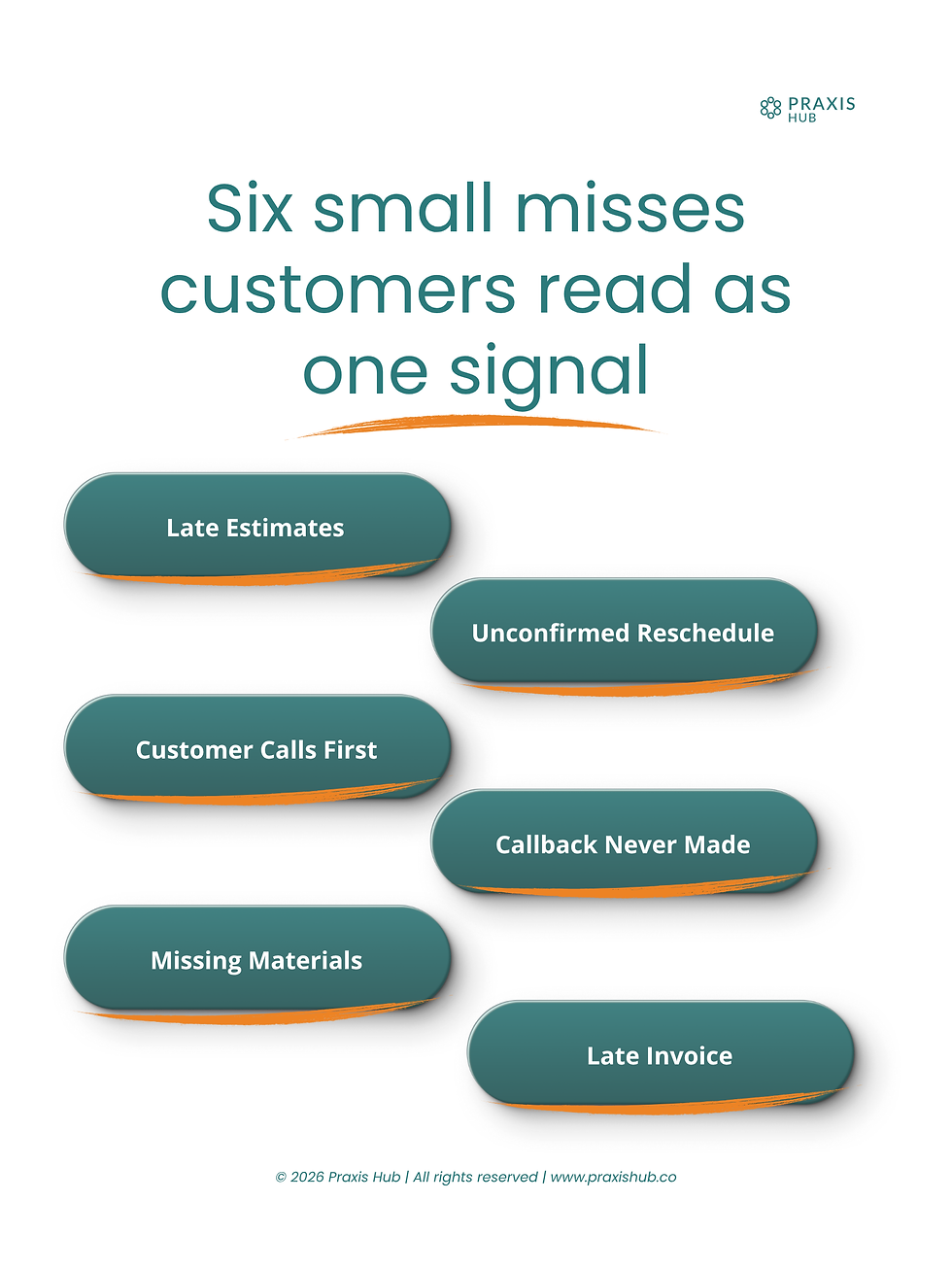
Punctuality is the miss customers see first and businesses notice last. A crew that arrives forty minutes late rarely feels late to itself. To the customer, it is the first promise the business broke, and it was a small one.
The clock is only part of it. Customers notice moments like these:
An estimate promised for Friday arrives Monday with no note about the delay
A rescheduled appointment goes out by text and nobody confirms it landed
The customer calls to ask where the crew is before anyone calls to say they are running late
A callback promised during the walkthrough never happens
The crew arrives without the materials discussed on the first call
An invoice arrives weeks after the job with no link to the work it covers
None of these is a quality problem. Each is a handoff nobody owned, and customers add them up faster than the business does. Customers forgive a delay they heard about early. They remember the one they had to ask about.
Where These Misses Start
These misses rarely start with the person who made them. They start in the back office: who owns the estimate, who sends the confirmation, who calls when the schedule slips, and who covers when that person is out. In most growing businesses, those jobs run on memory. They happen when the right person remembers on the right day.
Revenue comes from the front office. Cash flow is protected in the back office. Every estimate, confirmation and follow-up is back office work that the customer experiences as front office behavior.
When every confirmation routes through the owner, the owner's hour carries a price, and the cost of owner's time in business adds up fast. When the owner is on a job site, the call does not happen.
Fixing this is not a matter of working faster. Back Office Process Improvement exists for this: clear ownership, defined timing and a backup for every commitment a customer can see.
The Proximity Problem
Owners rarely see this pattern from the inside. A late estimate looks like a busy week, and a missed callback looks like a one-off. A customer sees six of those stacked together and reads one signal. That is not a competence gap. It is physics.
AI documents what you describe. It cannot see what you left out. The gap is never in what the owner knows. It is always in what the owner has stopped questioning. A handoff that fails once a week costs the business a customer's confidence every week, and no report records it.
Outside perspective, backed by financial and operational experience, finds in days what an owner has circled for years. What it finds is usually small. Fixing it changes what the customer sees: the estimate arrives when promised, the confirmation lands, and a delay gets announced before anyone has to ask.
Free Resource: System Leak Audit
Where these misses start is different in every business. The System Leak Audit is a self-scoring diagnostic across five categories of back office gaps. It ranks the findings by priority and flags quick wins. It takes about 15 minutes.
Get the System Leak Audit. See where your business stands.

Frequently Asked Questions
What is customer trust before service delivery?
It is the confidence a customer builds in a business before any work is done, based on how it handles calls, estimates, confirmations and follow-up. Customers cannot judge the work yet, so they judge the reliability of the business instead.
Why do customers judge reliability before they see the work?
They have nothing else to judge. Quality shows up later, and reliability shows up now. A late estimate or an unconfirmed appointment is the first proof of how the business keeps its word, so customers treat it as a preview of the rest of the job.
Is a late start really a big deal if the work is excellent?
It can be, because the customer may never get to the excellent part. A late start shows how the business handles small promises. Some customers stay and some quietly book someone else, and the business rarely hears which.
Is this a customer service problem or a back office problem?
Usually a back office problem. Customer service is where the customer feels it, but the cause sits upstream: nobody owns the estimate, the confirmation or the follow-up. The structure behind those jobs decides whether they happen on time, whoever is on shift.
How does this connect to cash flow?
Lost jobs reduce revenue, and questioned invoices slow collections. Both reach the bank account before they show up on any report. In my experience, a customer who trusted the business before the job reaches the invoice with fewer questions.
Ready to See Where Customers Lose Confidence Before the Work Starts?
If customers follow up with the business more often than the business follows up with them, that pattern is worth a conversation. A discovery call looks at where the commitments customers can see are slipping, and what sits behind each one.
The Back Office Brief
Get a weekly insight connecting back office operations to profit. Delivered every week, free.


Comments