
CRM Data Integrity: What Your Contact Database Is Actually Costing You

Your CRM is supposed to be an asset. A record of every lead, every conversation, every opportunity your business has built. But in many growing companies, that database has quietly become a liability, and the income statement is absorbing the damage without anyone naming the cause.
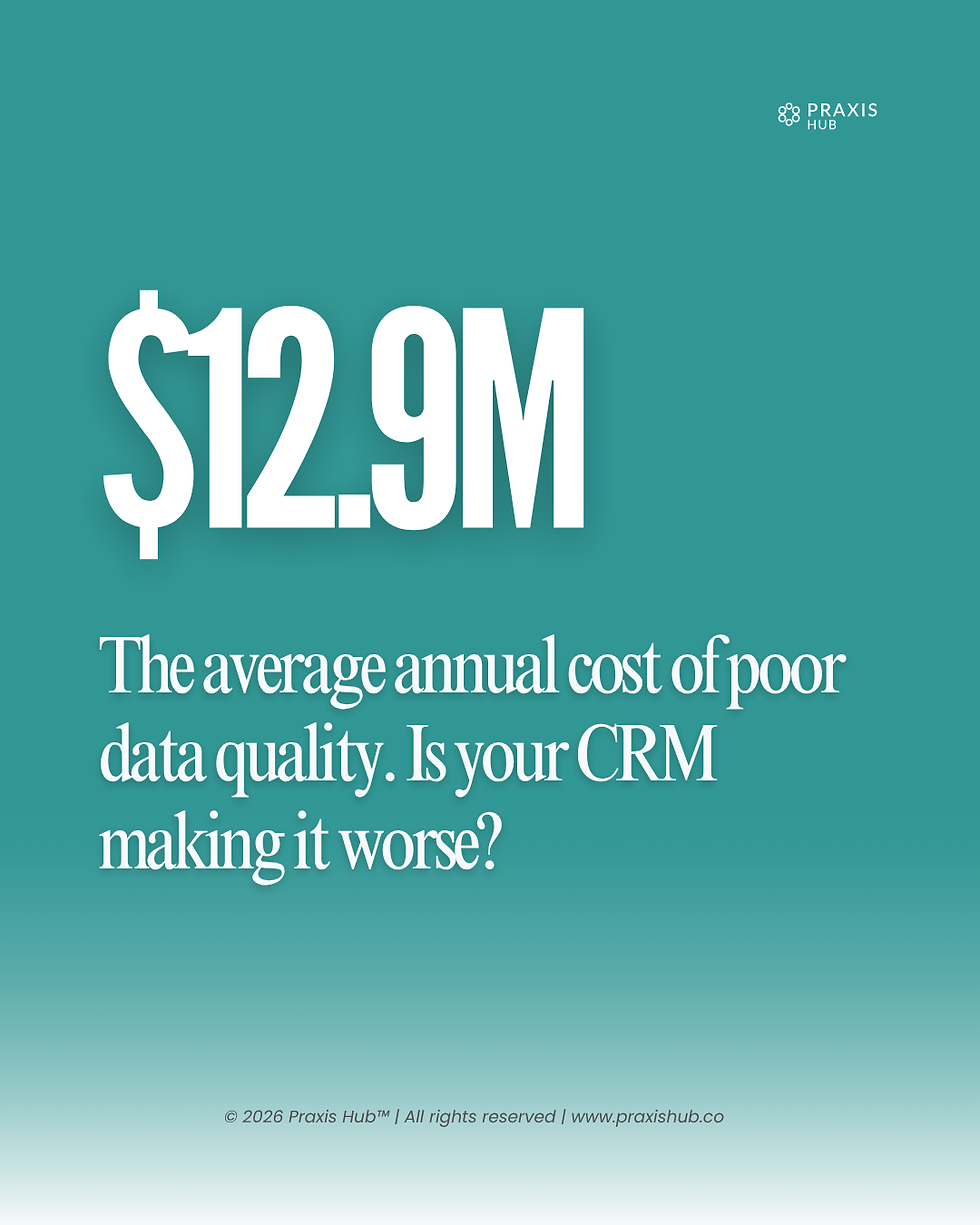
According to Gartner research cited by Dataversity, poor data quality costs organizations an average of $12.9 million per year. That figure accounts for wasted spend, labor inefficiency, and missed revenue. Most business owners register those losses as separate problems: marketing that underperforms, a sales team that seems demoralized, reports that never quite add up. The common thread underneath all of it is often CRM data integrity.
Table of Contents
The Financial Consequence Nobody Names
There is a category of financial loss that does not show up cleanly on any single line of the income statement. It is spread across marketing spend, labor hours, missed sales, and reporting errors. It is invisible in isolation. It is significant in aggregate. And it almost always traces back to the same place: a contact database that has accumulated noise faster than anyone has cleaned it.
The conversation about CRM problems tends to stay in the front office. Marketing is frustrated that retargeting is expensive and underperforming. Sales is frustrated that leads are not closing at the rate the reports suggest they should. The two sides blame each other. The actual culprit sits in the back office, in the structure of the database itself.
Revenue comes from the front office. Profit is protected in the back office. When the back office data infrastructure is broken, every dollar the front office spends on lead generation gets taxed by the inefficiency underneath it.
What CRM Data Integrity Actually Means
CRM data integrity refers to the accuracy, completeness, and uniqueness of the records inside a contact management system. A database with strong data integrity has one record per real contact. That record contains accurate information. The automation, reporting, and sales follow-up built on top of it is therefore reliable.
A database with poor CRM data integrity has the opposite: duplicate records, incomplete profiles, conflicting contact information, and automation sequences that fire multiple times for the same person. The system is technically running. It is not reliably serving the business.
This is a back office problem. The CRM is not a marketing tool. It is an operational infrastructure. It determines whether the investments made in the front office convert at the rate the business expects. When the database is compromised, those conversions do not happen, and the reporting does not tell the accurate story of why.
Where the Money Goes: Four Line Items
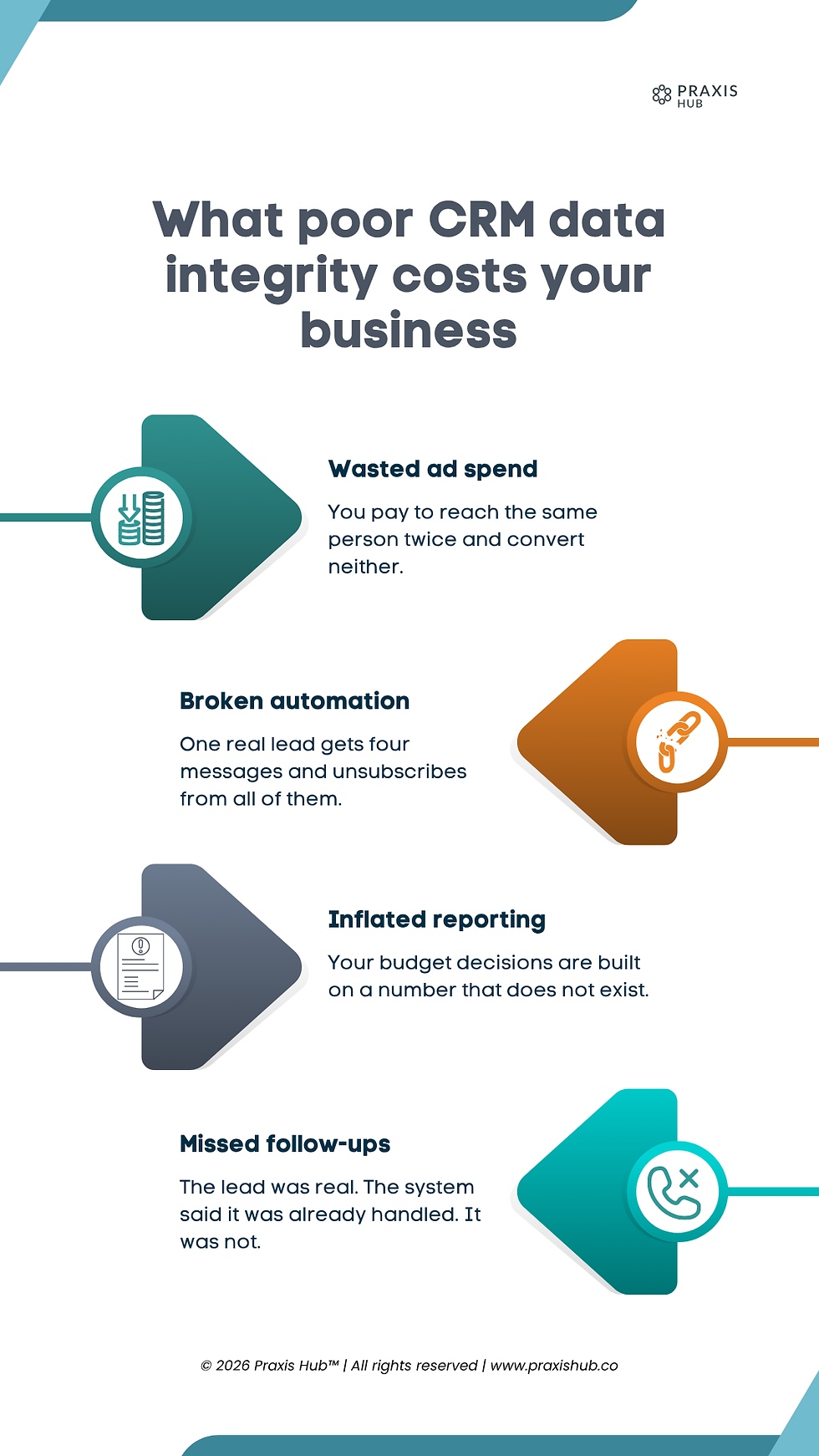
The financial impact of poor CRM data integrity concentrates into four categories. Each one represents a named cost that sits on the income statement without a label attached to it.
Retargeting spend reaching the same person multiple times under different records, paying full CPM for zero additional reach
Automation sequences firing three and four times per real contact, accelerating unsubscribes and driving down deliverability for the entire list
Reporting that shows twice the leads that actually exist, producing budget allocation decisions built on inflated numbers
Follow-ups that never happen because a duplicate record shows the lead as already contacted, and the sales team acts on that information correctly
The pattern behind each of these is the same. The business is not making errors. It is operating logically inside a database that is not telling the truth. Retargeting spend is calculated on audience size. When that audience is inflated with duplicates, every dollar spent reaches fewer real people than the platform reports. Automation sequences are designed to run once per contact. When one real person exists in the database three times, the sequence runs three times. The recipient marks it as spam. Deliverability drops across the full list, not just for that individual.
The reporting consequence is the most strategically dangerous. When a database carries 50% duplicate records, the monthly lead count is twice the real number. Budget allocation, campaign scaling decisions, and staffing models are built on that figure. The business is making real financial commitments based on data that does not reflect reality. When results fall short of projections, the gap looks like a front office failure. The cause is in the back office.
Why the Problem Outlasts Every Cleanup Effort
Growing businesses typically address duplicate records by assigning someone to review and merge them manually on a recurring basis. This approach has a structural flaw. By the time the review is complete, new duplicates have already entered through the same channels that created the original problem.
The channels that generate duplicates are not accidents. They are the reality of multi-channel lead generation. A prospect who encounters the business through two different campaigns fills out two slightly different forms. The name, phone number, or email address differs. The CRM creates two records. This pattern repeats across every lead source the business operates. Manual intervention cannot keep pace with it.
The business treats CRM data integrity as a maintenance task when it is an operational design problem. The fix is structural, not periodic. Any tool applied to a compromised database will produce compromised results. The database has to be right before anything layered on top of it can perform reliably.
CRM Data Integrity and Your Back Office
The CRM is typically categorized as a front office tool because it supports sales and marketing. But the integrity of the data inside it is a back office function. The back office is where operational controls live, where accuracy and the reliability of business information are maintained, and where profit is protected.
A business can generate strong revenue from the front office and lose a significant portion of it to back office infrastructure that is not working. Wasted ad spend is a direct reduction in marketing ROI. Inflated reporting produces misallocated budget. Missed follow-ups are lost deals that never appear on a revenue report because they never received a fair attempt.
None of these losses show up as a single named line item. They show up as disappointing margin, underperforming campaigns, and a team that cannot explain why the numbers are not matching the activity. A leaky back office is a tax on every dollar the front office earns. Duplicate contact records are one of the more expensive leaks in a growing company, and one of the least visible until someone examines the database itself.
Why Outside Perspective Helps
You cannot see what is broken in a system you built and live inside every day. That is not a failure of intelligence. It is a structural limitation. The people closest to a CRM are also the people most accustomed to working around its inconsistencies. They have adjusted their habits to compensate for what the database gets wrong. Those adjustments feel normal. The underlying problem becomes invisible.
The pattern I see across different industries is consistent: the business has lived with the symptoms long enough that the symptoms no longer register as connected to a single cause. Marketing and sales are each holding a piece of the problem. Nobody is holding the whole picture. That is not a team failure. It is a proximity issue.
An outside review of data infrastructure brings a different vantage point. It asks the question the internal team stopped asking: what is the actual state of the database, and what is it costing the business right now? The answer to that question is almost always larger than the team expects.
Free Resource: System Leak Audit
If you are not sure where your business is losing money in the back office, the System Leak Audit is a free diagnostic that identifies operational gaps across five categories of back office function. Data infrastructure, including CRM data integrity, is among the areas it covers. It takes approximately ten minutes and produces a clear picture of where your systems may be taxing your profitability.

Ready to Action
CRM data integrity is not a technology problem. It is an operational design problem with direct financial consequences. If your marketing spend is not converting at the rate it should, if your reports are telling one story while your results tell another, and if your sales team has learned not to fully trust the data in front of them, the issue may already be present in your database.
The same pattern appears across every business that adds tools before fixing the structure underneath them. If you have not read Fix Process Before Tech, that piece gives the broader context for why data infrastructure has to come before any technology investment produces reliable returns.
The Business Process Improvement work at Praxis Hub includes a structured review of the back office infrastructure that supports front office performance. That includes data systems, process controls, and the operational structures that determine whether the business's investments produce the return the income statement is supposed to reflect.
Let's Talk About Your Business
If you want to understand what this looks like inside your operations specifically, book a discovery call. It is a direct conversation about what is actually happening in your back office and where the financial exposure is. No pitch deck. No pressure.
Frequently Asked Questions
What is CRM data integrity and why does it affect profitability?
CRM data integrity refers to the accuracy and uniqueness of records in a contact management system. When a database contains duplicate records, incomplete profiles, or conflicting contact information, the automation, reporting, and sales follow-up built on top of it become unreliable. The financial consequences include wasted ad spend, declining email deliverability, inflated lead counts that distort budget decisions, and missed follow-ups on real opportunities. These losses do not appear on a single income statement line. They accumulate across marketing, sales, and operations simultaneously.
How do duplicate records enter a CRM in the first place?
Duplicate records typically enter through the same channels that generate leads. A prospect who submits two different forms, uses both a business and personal email address, or encounters the business through multiple campaigns will often appear as two or more separate contacts. Phone number formatting variations and name inconsistencies across touchpoints compound the problem. In a multi-channel business with active lead generation, new duplicates enter faster than manual review processes can remove them. This makes the problem structural rather than a question of individual carelessness.
Is CRM data integrity a marketing problem or an operations problem?
The CRM is often categorized as a marketing or sales tool, but the integrity of the data inside it is an operational responsibility. The back office is where accuracy and process controls belong. When CRM data integrity breaks down, the consequences appear across the income statement: in marketing ROI, in sales conversion rates, and in the reliability of the financial reporting that guides business decisions. The fix requires operational design, not just a technology change or a one-time cleanup.
Can a tool solve a CRM data integrity problem on its own?
Technology can help identify and merge duplicate records. What it cannot do is maintain data integrity in a system where the processes feeding the CRM are not designed to prevent duplicates from forming in the first place. A cleanup without a process change is a temporary fix. The database will return to a compromised state through the same channels that created the original problem. Sustainable CRM data integrity requires process design alongside any tool implementation.
How do I know if my business has a CRM data integrity problem?
Several signals are common. Marketing spend on retargeting is producing a high cost per result relative to the size of the audience. Email open rates are declining while unsubscribe rates are rising. Sales reports show a lead volume that does not match the conversion activity the team can account for. Strategic decisions about campaign scaling or team staffing have been made based on metrics that later proved unreliable. Any one of these patterns warrants a closer look at the database itself. The System Leak Audit is a free starting point for that review.
The Back Office Brief
Get a weekly insight connecting back office operations to profit. Delivered every week, free.



Comments