
Before You Scale Your Business, Check What You Are Scaling

Most business owners treat growth as the solution. If revenue is tight, scale up. If the team is stretched, scale up. If operations feel messy, scale up and hire your way out of it. The problem is that scale is not a solution. It is a multiplier. And a multiplier works in both directions.
This pattern shows up across industries. The businesses that run into serious trouble during a growth phase are rarely undone by the market or by a lack of capital. In my experience, the breaking point almost always traces back to something that was already there before the decision to grow was made. The business did not break because it grew. It broke because growth made the existing cracks impossible to ignore.
Table of Contents
Growth Does Not Fix What Is Broken
There is a version of scale that works. Processes are documented. Roles are defined. Handoffs happen without the owner in the middle of every one. Information moves through the organization without getting lost. When more volume comes in, the system absorbs it.
There is another version that does not. The owner is still the connective tissue between every department. Approvals pile up because nothing is delegated in writing. Customer issues get escalated because the team does not have a defined path to resolution. Back office tasks fall through because ownership was never assigned.
In the first version, scale is a reward. In the second, it is a stress test the organization is not ready to pass.
What is telling is how often owners arrive at a scaling decision without asking which version they are operating in. The intent to grow is real. The plan is funded. The market is there. But the internal infrastructure has not been evaluated. And infrastructure does not show its weakness until the weight is on it.
What Actually Gets Amplified When You Scale
Scale does not transform operations. It intensifies what is already there.
If the hiring process is inconsistent, adding headcount makes it more inconsistent. If the onboarding process depends on whoever has time that week, a larger team means more people who were never properly brought in. If the approval chain runs through the owner for decisions that do not require owner involvement, doubling revenue doubles the bottleneck.
This pattern shows up across industries. The businesses that scale cleanly are not necessarily the ones with the best products or the most funding. They are the ones where someone stopped before growth began and asked what they were actually building on.
The ones that struggle share something in common: the operational gaps were already present. They just were not visible at smaller volume. Scale made them visible. By that point, the cost of fixing them is higher, the disruption is greater, and the owner is managing a crisis instead of managing growth.
What Scale Costs When the Foundation Is Not Ready
The operational gaps that exist before a scaling decision are not just inconveniences. Each one has a line on the income statement.
When processes are undocumented and owner-dependent, the owner's time becomes an operating cost that does not appear in the budget but shows up in everything else. Decisions wait. Approvals stack. Work that should move without intervention sits until the owner gets to it. At small volume, this is manageable. As revenue grows, the cost of that delay compounds. Deals slow down. Errors that would have been caught get missed. The owner is now managing growth and patching the operation at the same time, and neither gets full attention.
When back office functions are handled informally, the error rate that was tolerable at smaller volume becomes material. Duplicate payments, unbilled work, and missed reconciliations do not disappear as the business grows. They increase in frequency because more transactions are moving through a system that was never designed to handle the volume. What showed up as an occasional write-off becomes a predictable monthly drain on gross margin.
When roles lack documented accountability, overhead grows faster than revenue. Gaps in coverage get filled by whoever has time, which means the owner, senior staff, or nobody. Hiring to fix an unclear role produces a hire who cannot succeed because the role was never defined. That is not a talent problem. It is an overhead problem with a payroll line attached to it.
The financial consequence of scaling without operational readiness is not theoretical. It shows up in margin compression, rising overhead as a percentage of revenue, and cost-per-transaction increases that erode the profitability of every dollar of new revenue the growth was supposed to produce.
The Five Decision Points This Series Has Covered
This post is the sixth in the Before You Do X series. Each post addressed one specific moment where a business decision gets made without the operational foundation to support it.
Before you automate your business, the question is whether your processes are clean enough to automate or whether you are about to lock in dysfunction at scale. That post covers what needs to be in place first.
Before you buy business software, the question is whether you have a technology gap or a process gap. Software layered on top of a broken process does not fix the process. It adds cost to it. That distinction is worth understanding before the purchase decision is made.
Before you hire your next employee, the question is whether you actually need a person or whether you need to redistribute what the owner is still holding. That post walks through how to tell the difference.
Before you outsource business operations, the question is whether what you are handing off is defined clearly enough for a vendor to execute. Vendors inherit your gaps and charge you for them. That post covers what has to be documented before anything gets handed off.
Before you migrate to a new system, the question is whether the problem you are trying to solve is a technology problem or an operational one. A new system moves your data. It does not move your process gaps. That post explains what to resolve before the migration begins.
Each of those five decisions carries the same underlying truth: the move itself is not the risk. The risk is making the move without knowing what is underneath it.
Scaling is not a different category of decision. It is the one that brings all five of the others together.
Before You Scale Your Business: What to Evaluate First
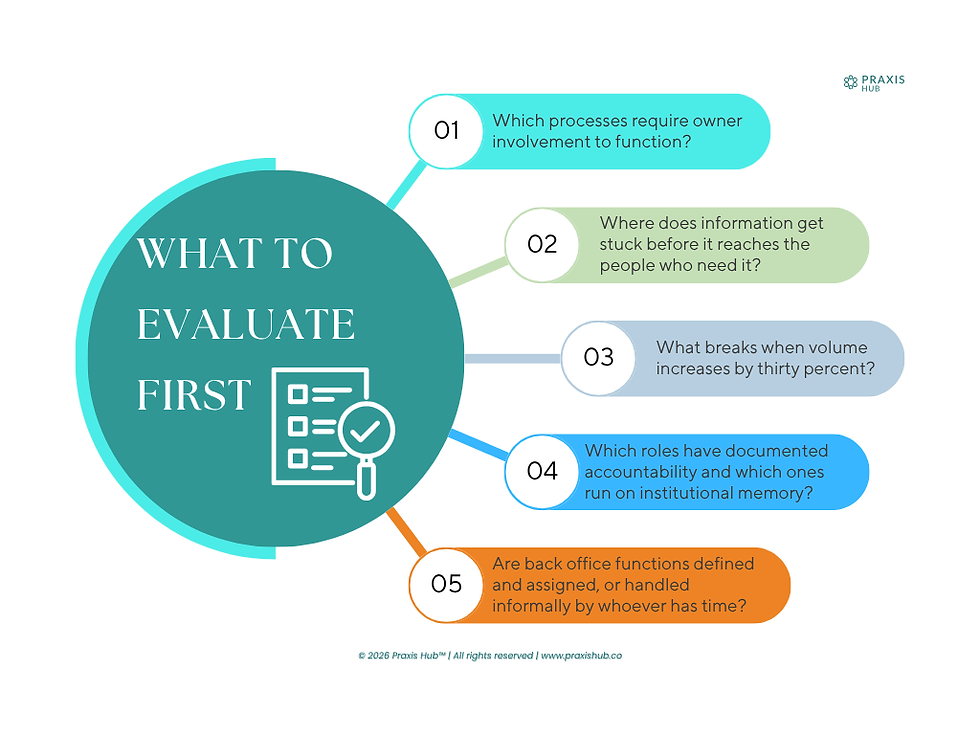
The evaluation that needs to happen before scale is not a financial one. The financials matter, but most owners have already done that work. What gets skipped is the operational audit. In my experience, the questions that reveal the most are not the ones about strategy. They are the ones about how the operation actually runs on an ordinary Tuesday.
Which processes require owner involvement to function?
Where does information get stuck before it reaches the people who need it?
What breaks when volume increases by thirty percent?
Which roles have documented accountability and which ones run on institutional memory?
Are back office functions defined and assigned, or handled informally by whoever has time?
These questions do not require a consultant to answer. They do require honest answers, and honest answers are harder to produce from inside the operation than most owners expect.
Why Outside Perspective Helps
A business owner cannot audit their own blind spots. This is not a capability issue. It is a structural one. When you built the operation, you made thousands of small decisions that felt logical at the time. Those decisions are invisible to you now because they are the water you swim in. What looks like a functioning system from the inside often looks like a series of workarounds from the outside.
In my experience, the gaps that cause the most damage during a scale attempt are almost never the ones the owner identified. They are the ones the owner had stopped noticing because they had been managing around them for long enough that the workaround felt normal.
That is the moment outside perspective earns its value. Not by telling the owner something they could not have figured out eventually. By seeing it faster, before the cost of scale makes it expensive.
Free Resource: System Leak Audit
The System Leak Audit is a structured diagnostic that identifies where profit is leaking through operational gaps. It evaluates five categories: process gaps, delegation failures, system misalignment, communication breakdowns, and back office overhead that should not exist at your current size.
Before you scale your business, this audit gives you a clear picture of what is ready and what is not. Growth built on a clean foundation is a different outcome than growth built on assumptions that have never been tested.
Get the System Leak Audit — See where your business stands before you grow it.
Frequently Asked Questions
What does it mean to scale your business operationally?
Scaling operationally means increasing revenue or output without a proportional increase in the owner's time or overhead costs. It requires that the systems, roles, and processes supporting the business can absorb more volume without depending on manual intervention at every step. Financial scaling and operational scaling are not the same thing, and businesses that confuse the two often grow revenue while shrinking margin.
How do I know if my business is ready to scale?
A business that is ready to scale can answer three questions clearly: which processes run without owner involvement, where accountability lives in writing rather than memory, and what breaks when volume increases. If those answers are vague or unknown, the business has work to do before growth begins. That is not a reason to delay the goal. It is a reason to sequence it correctly.
What are the most common operational gaps that show up during scaling?
The most common gaps are undocumented processes that depend on specific individuals, approval chains that run through the owner for decisions that do not require owner judgment, and back office functions that are handled informally. These gaps are manageable at small volume. At scale, they become the source of service failures, turnover, and margin loss.
Can I fix operational gaps while scaling at the same time?
In some cases, yes. In many cases, trying to fix the foundation while adding weight to it extends the timeline and increases the cost of both. The sequencing question is worth taking seriously. Businesses that pause long enough to close the most significant gaps before scaling typically move faster once they start than businesses that try to fix and grow simultaneously.
What is the difference between a process gap and a systems gap?
A process gap is a missing or unclear workflow that causes inconsistent output or requires manual judgment where a defined path should exist. A systems gap is a technology or infrastructure limitation that prevents the process from being executed efficiently. Both categories affect scalability, but they require different solutions. Buying software to solve a process gap, or redesigning a process to compensate for a missing system, are among the most common sources of wasted operational spend.

Ready to Take a Closer Look?
If you are planning to grow and want to know what your back office can absorb before you put weight on it, a discovery call is the right starting point. We look at what is there, what is missing, and what needs to be in place before growth begins.
The Back Office Brief
Get a weekly insight connecting back office operations to profit. Delivered every week, free.



Comments