
Before You Outsource Business Operations

The company brings in a vendor to take over a set of business operations. The contract is signed. The kickoff call happens. Then the invoices start coming in with line items no one expected. Scope expands. Questions multiply. What was supposed to reduce cost is now increasing it, and no one inside the company can explain exactly why.
This pattern shows up across industries whenever an outsourcing decision is made before the underlying operations are understood. The vendor did not create the problem. The problem was already there. The vendor simply found it, and charged accordingly.
Table of Contents
Why Outsourcing Costs More Than Expected
The decision to outsource usually starts with a number. An owner looks at what an internal function costs and decides that number is too high. A vendor promises to deliver the same outcome for less. The math looks reasonable on paper.
What the math does not account for is the cost of the gaps that travel with the work.
Every business function that moves to a vendor carries whatever was built into it at the time of transfer. If the handoff documentation is incomplete, the vendor builds their own. If the process has informal workarounds that only certain employees knew about, those workarounds disappear when the work leaves the building. If the expectations were never written down, the vendor interprets them. That interpretation costs money every time it does not match what the owner had in mind.
Scope creep in outsourcing relationships is rarely the vendor's fault. It is usually the predictable result of handing off something that was not fully defined.

What Vendors Inherit When You Outsource
A vendor does not receive a process. They receive whatever currently exists. That includes the parts that work and the parts that do not.
In my experience, most business owners have a general understanding of what a function is supposed to produce, and a much thinner understanding of how that production actually happens day to day. The people who do the work know the details. The owner knows the output. The gap between those two levels of knowledge is exactly what gets outsourced along with the function itself.
A vendor operating inside that gap has two choices. They can flag every ambiguity and ask for guidance, which adds time and billing cycles. Or they can make judgment calls and keep moving, which produces results that may not match what the owner expected. Neither option is the vendor failing. Both are the direct result of handing off undefined work.
The outsourcing relationship that keeps expanding scope, generating unexpected invoices, and producing friction at every review cycle is almost always tracing back to what was not documented before the transfer happened.
The Financial Impact of Outsourcing Undocumented Work
The financial exposure in an outsourcing arrangement goes in several directions at once, and most of it is invisible until the relationship is already underway. The original quote reflects the scope that was defined. What generates cost is everything that was not.
In my experience, the gaps that drive cost overruns in outsourcing engagements follow recognizable patterns across industries:
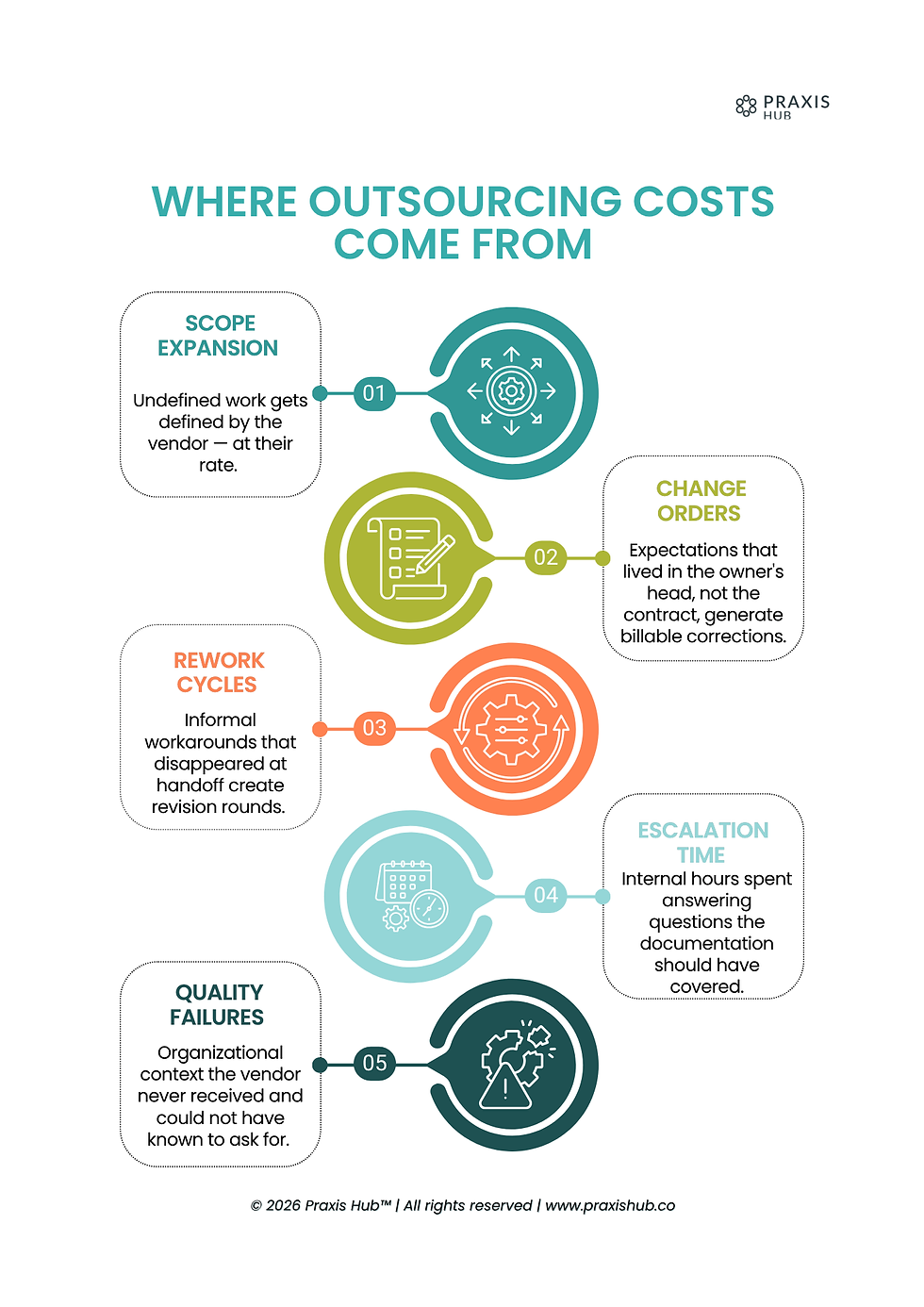
Scope expansion driven by undefined handoff criteria, where the vendor fills the gaps and bills for the interpretation
Change orders generated by expectations that existed in the owner's head but never appeared in the contract
Rework cycles caused by informal workarounds that disappeared when the work left the building
Escalation time absorbed internally while the owner answers questions the documentation should have addressed
Quality failures traceable to organizational context the vendor never received and could not have known to ask for
These are not random events. They are the predictable financial outcome of transferring work before the work is defined.
In my experience, businesses that outsource before they have documented their operations consistently spend more in the first 12 months than they projected for the entire engagement. The savings are real in principle. They are difficult to realize in practice without the operational foundation in place first.
Outsourcing reduces cost when the function is clean. It amplifies cost when the function has unresolved gaps. The variable is not the vendor. The variable is the state of the work at the time of transfer.
Before You Outsource Business Operations: What Needs to Be in Place
The question is not whether outsourcing is a good idea. For many functions, it is an excellent idea. The question is whether the business is ready to hand it off.
Readiness has a specific meaning here. It is not about being perfect or having every detail documented at an enterprise level. It means the person receiving the work can operate it without requiring the owner's ongoing interpretation.
That requires a few things to be true. The function needs to have defined inputs — what triggers it, what information it requires, and who is responsible for providing that information. It needs defined outputs — what the result looks like, what quality means, and how it gets measured. And it needs a documented path between the two that does not live only in the head of one employee or the owner.
When those elements are in place, a vendor can be onboarded with precision. Scope can be defined in writing. Expectations can be measured against something real. And when something goes wrong, there is a documented baseline to return to.
When those elements are not in place, the outsourcing engagement becomes a discovery process. Discovery processes are billed by the hour.
For companies that have looked at software as a solution to similar problems, the same foundation applies. The post Before You Buy Business Software covers why tools do not resolve system gaps — they layer on top of them. The same principle holds here. Vendors inherit what exists. They do not fix it by taking it over.
Business process improvement work addresses exactly this layer — getting the operational foundation documented and organized before decisions like outsourcing are made.
Why Outside Perspective Helps
The challenge with getting operations documented before an outsourcing decision is that the documentation requires someone who can see the whole system. The people inside the business see the parts they work on. The owner sees the output. Nobody is positioned to see all of it at once.
This is not a failure of effort or awareness. It is a structural limitation that comes with proximity. You cannot audit what you have built and lived inside without some distance from it.
In my experience, business owners who attempt to document their own processes before an outsourcing engagement consistently miss the same categories of gaps. Not because they do not know the business. Because the gaps are in the spaces between what they think the business does and what the business actually does. Those spaces are invisible from the inside.
A second set of eyes with operational experience can locate those gaps in a fraction of the time it takes to find them through vendor escalations and unexpected invoices. The cost of identifying them in advance is always lower than the cost of discovering them mid-engagement.

Free Resource: System Leak Audit
The System Leak Audit looks at five categories of operations where gaps commonly exist before an outsourcing or vendor relationship begins. It gives you a picture of what is actually ready to hand off and what still needs attention first.
Get the System Leak Audit — See where your operations stand before the vendor does.
Frequently Asked Questions
What does it mean to outsource business operations?
Outsourcing business operations means transferring the responsibility for a business function to an external vendor or service provider. This can include functions like accounting, HR administration, customer service, fulfillment, IT support, or any other repeatable business process. The vendor performs the work according to a defined agreement, and the business pays for the outcome rather than maintaining internal staff for that function.
Why do outsourcing costs often exceed what was originally projected?
Outsourcing costs expand when the scope of the work was not fully defined before the engagement began. Vendors operate based on what is documented and agreed upon. When gaps exist in that documentation, they fill them through interpretation, questions, and change orders, all of which generate additional cost. The original quote reflects defined scope. Undefined scope generates a different number.
How do you know if a business function is ready to be outsourced?
A function is ready to outsource when it can be handed off without the vendor needing to rely on the owner or a specific internal employee to interpret or clarify how the work is done. That requires documented inputs, defined outputs, and a process path between them that can be followed by someone who did not build it. If the work depends on informal knowledge or undocumented judgment calls, it is not ready yet.
What is a vendor gap, and how does it affect the outsourcing relationship?
A vendor gap is the space between what the business expected the vendor to do and what the vendor was actually equipped to do based on what was handed off. These gaps usually trace back to undocumented processes, missing context, or undefined expectations rather than vendor performance issues. They show up as rework, miscommunication, scope disputes, and invoices that do not match the original estimate.
Can before you outsource business operations decisions be reversed if they go wrong?
Outsourcing relationships can be ended, but the cost of unwinding them is significant. Bringing a function back in-house requires rebuilding the internal capacity that was dissolved when the function left. If the original process was not documented before the transfer, the business may be rebuilding from scratch rather than recovering something that was preserved. The cleaner path is to invest in documentation before the outsourcing decision is made, not after the relationship has already created problems.
Ready to Take a Closer Look?
If an outsourcing decision is already on the table, the right question is not whether to move forward. It is whether the operations are ready for the transfer. The System Leak Audit looks at five categories of your back office operations to show you what is actually prepared to hand off and what still needs attention.
The Back Office Brief
Get a weekly insight connecting back office operations to profit. Delivered every week, free.



Comments