
Workload Tracking for Small Business: Facts Over Gut Feel

Your team looks busy. Deadlines are mostly met. No one is complaining loudly. And yet something in the numbers does not add up. Payroll is one of the largest line items in the business, and the output does not always match what that investment should produce. That gap rarely has an obvious explanation. It usually has a visibility problem underneath it.
What Gut-Feel Management Actually Costs You
Gallup research on employee burnout has found that employees who regularly experience burnout are 2.6 times more likely to be actively looking for a new job. Burnout is not always about overwork in the traditional sense. It is often a product of uneven distribution, where certain people carry disproportionate weight while others operate well under capacity. The business pays the same labor cost either way. The output is not the same. And when a burned-out employee walks, the cost to replace them typically runs between one-half and two times their annual salary, before factoring in the institutional knowledge that leaves with them.
Revenue comes from the front office. Profit is protected in the back office. Workload distribution is a back office function, and when it is not managed with data, it quietly taxes every dollar the front office earns.
Making a staffing or workload decision based on internal whispers is not intuition. It is the absence of data dressed up as leadership. The business owner who assumes their team is balanced because no one is complaining is operating on hope, not information.
This pattern shows up across industries more than most owners realize. The team looks functional on the surface. Deadlines are mostly met. People seem busy. But underneath that surface, the actual distribution of work is often wildly uneven, and no one in leadership has the numbers to see it.
The cost is real. Overloaded employees make more errors, miss details, and eventually leave. Underutilized employees disengage, stop contributing at full capacity, and sometimes find ways to look productive without being productive. Both conditions are expensive. Neither shows up visibly until the damage is already done.
This is not a team problem. It is a visibility problem. The data to fix it exists inside the business right now. The issue is that it has never been captured in any form that makes the picture clear.
What Visibility Reveals: The Three Patterns
In my experience across different industries, when task-level visibility gets introduced into a team for the first time, three patterns surface almost immediately. They are predictable enough that I have come to expect all three, not some of them.
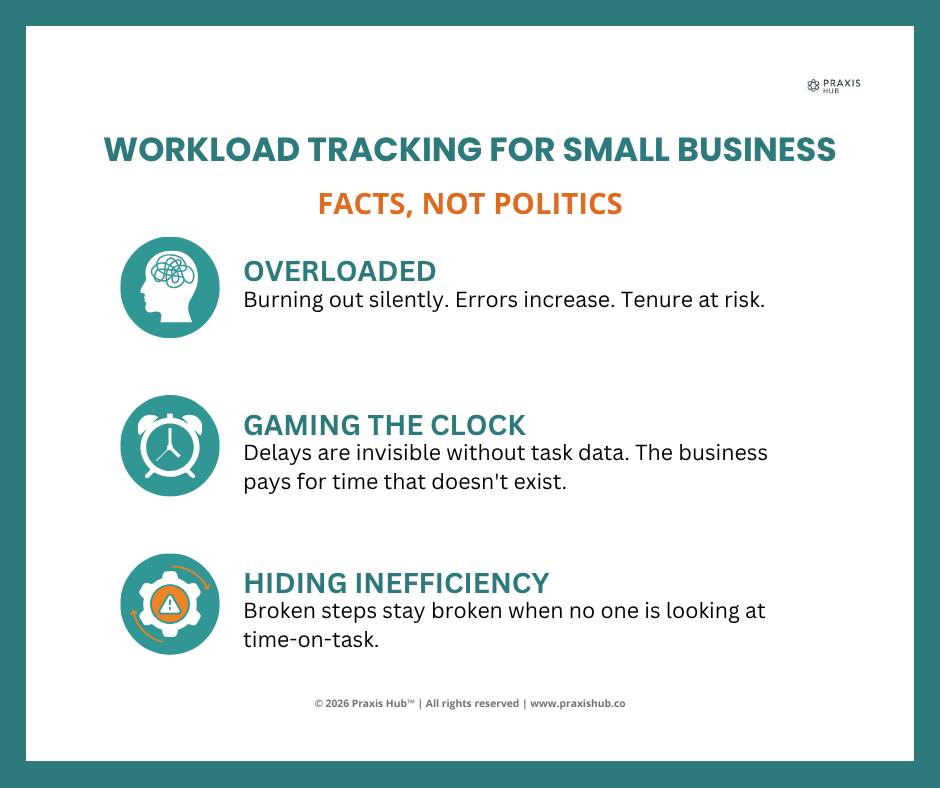
Pattern one: workload imbalance. Some employees are genuinely overloaded. Others have significant capacity the business is not using. This is almost never by design. It develops gradually as tasks accumulate unevenly and no one tracks the distribution. By the time it becomes obvious, the overloaded person is burning out and the underloaded person has mentally checked out. The financial consequence shows up as turnover, errors, and missed deadlines. The business is paying full labor cost for partial output on both ends.
Pattern two: timing manipulation. Some employees delay the start or completion of tasks to appear busier than they are. This is not laziness in the traditional sense. It is a rational response to an environment where there is no visibility structure. If no one is tracking when work starts and stops, there is no cost to extending a task that should take two hours into a task that takes two days. The employee looks busy. The business absorbs the cost. Over a team of ten, that kind of untracked drag can represent tens of thousands of dollars in annual labor spend with nothing to show for it on the income statement.
Pattern three: hidden inefficiencies. Some processes are broken in ways that only become visible when you can see time-on-task data. A step that should take thirty minutes is consistently taking three hours. That gap is not random. There is a reason for it. But without the data, no one investigates it, and the inefficiency compounds quietly over time. This is the kind of back office problem that does not show up on a marketing dashboard. It shows up on the income statement, in the margin that should be there but is not.
None of these patterns mean the team is bad. They mean the system has no mechanism to surface problems, so problems stay hidden until they become expensive.
The Yellow Legal Pad Principle
There is a tendency to assume that fixing an operations problem requires a sophisticated system. New software, a new platform, an implementation project. That assumption is one of the reasons businesses stay stuck.
Workload tracking for small business does not require sophistication. It requires discipline.
A legal pad, a shared spreadsheet, a whiteboard with columns. The format is not what matters. What matters is the consistent habit of capturing who is working on what, when it was assigned, and when it was completed. That basic discipline creates the data that makes decisions possible.
The irony is that complicated systems often make the problem worse, not better. Overly complex tracking tools create three predictable outcomes: employees find workarounds, the data becomes unreliable, and leadership loses confidence in the numbers. A system nobody uses accurately produces no useful data. It produces noise.
Simple, consistent, and visible beats complex and abandoned every time. The businesses that have real operational visibility are not the ones with the most sophisticated tools. They are the ones that built the habit of looking at the work, at the task level, on a regular basis.

Workload Tracking for Small Business: Where to Start
The businesses that do this well share a few common characteristics. First, they have decided that opinion is no longer sufficient. Decisions about staffing, workload, and performance will be made with data, not politics. That decision has to come from the top, because it changes how everyone on the team operates.
Second, they start simple. A list of active tasks, assigned owners, and target completion dates is enough to begin. That list does not need to live in an expensive tool. It needs to be visible to whoever is managing the work, updated consistently, and reviewed on a regular cadence.
Third, they look at the data without bias. This is harder than it sounds. When the numbers show that a high-tenure employee is gaming timing, or that a department manager's team is severely overloaded, there will be a temptation to explain it away. The businesses that get value from the data are the ones that let it tell the story rather than editing the story before it is finished.
What that process produces is the ability to rebalance workload with facts, not politics. Decisions about who gets which assignment, who needs support, and where the process is broken become defensible and clear. That is a different kind of operation than the one running on gut feel.
Why an Outside Perspective Accelerates This
There is a reason this is difficult to build from inside the business. It is not a question of intelligence or effort. It is a proximity problem.
When you are inside the operation every day, the patterns become invisible. You have history with the people on the team. You have assumptions about who is capable of what. You have political dynamics that make certain conversations feel risky. An objective outside eye does not carry any of that weight. It looks at the data without the relationships attached to it, and it can name what it sees.
The Business Process Improvement Services at Praxis Hub are built specifically for this kind of work. Not to install complicated new systems, but to bring the structured approach and experienced judgment needed to build the visibility infrastructure that lets businesses make decisions based on what is actually happening, not what feels like it is happening.
That distinction matters. The back office does not show up on your marketing dashboard. It shows up on your income statement. Operational control over workload distribution is how the profit the front office earns actually stays in the business.
Free Resource: System Leak Audit
If this post is describing something that feels familiar in your business, the System Leak Audit is the right starting point. It is a structured assessment across five operational categories that identifies exactly where the hidden costs and inefficiencies are living in your back office.
Visibility problems rarely stay in one area. They tend to cluster in patterns that the audit is designed to surface. The result is a clear picture of where the leaks are, which makes the path forward much less guesswork.
Frequently Asked Questions
What does workload tracking for small business actually involve?
At its most basic level, workload tracking means capturing who is working on what tasks, when those tasks were assigned, and when they are completed. That data does not need to live in a specialized tool. It can start with a shared document or even a physical tracking sheet. The discipline of capturing and reviewing that information consistently is what produces useful data over time. Sophistication is optional. Consistency is not.
How do I know if my team's workload is unbalanced?
The clearest sign is that some employees are consistently behind while others appear to have bandwidth they are not using. Other indicators include missed deadlines concentrated among certain team members, tasks that consistently take longer than expected without explanation, and general patterns where the same people are always at capacity and others rarely are. Without a tracking structure, these patterns are easy to miss or misread.
Is it possible to do workload tracking without expensive software?
Yes. The tool is not the point. A spreadsheet with task names, assigned owners, start dates, and completion dates is enough to start seeing patterns. Many businesses discover their biggest operational blind spots through the simplest possible tracking methods before ever investing in a platform. The value is in the habit of capturing and reviewing, not in the sophistication of the system.
What is the difference between monitoring employees and tracking workloads?
Workload tracking is focused on tasks and processes, not on employee behavior. The question being answered is not "what is this person doing at 2pm" but "what tasks are active, who owns them, and how long are they taking." That information is about operational visibility and resource allocation. It surfaces process inefficiencies and imbalances that no individual is necessarily responsible for. The goal is a healthier distribution of work, not surveillance.
When should a business owner bring in outside help for this?
When the internal attempt to build visibility has stalled, when the relationships inside the team make it politically difficult to look honestly at the data, or when the business has been operating on gut feel long enough that the patterns are deeply embedded. An outside perspective removes the relational weight from the analysis and makes it possible to see what the data actually shows. The Delegate Without Hiring fractional chief of staff service is one way growing businesses bring in that level of structured support without a full-time executive hire.

Ready to Talk About What You Are Seeing?
If the patterns in this post are showing up in your business, a discovery call is the right next step. Not a sales pitch. A conversation about what is actually happening in your operation and what it would take to fix it.
The Back Office Brief
Get a weekly insight connecting back office operations to profit. Delivered every week, free.



Comments