
Why Smart Business Owners Burn Out: The Real Cost of Staying the Bottleneck

Smart owners are not supposed to burn out. They are supposed to be the ones who figure it out, who work the problem until it moves, who outlast whatever the market throws at them. And yet the pattern shows up again and again: the sharpest, most capable owner in the room is also the most exhausted one.
That is not a coincidence. According to Gallup research on entrepreneurial talent, only one in four employer entrepreneurs have high natural talent for delegation. The other three out of four run their business the way they started it: by doing it themselves. That approach works when the business is small. It becomes the ceiling once the business grows past what one person can carry.
A Pattern, Not a Person
Here is a pattern I have seen play out the same way across different industries. A business owner builds something real. Revenue grows. The team grows. And somewhere in that growth, the owner quietly becomes the ceiling on how fast any of it can move.
Let's say a business owner is approving every invoice over five hundred dollars, sitting in on every client call that matters, and reviewing every piece of content before it goes out. None of that looks like a problem from the outside. It looks like diligence. It looks like someone who cares about quality. But every one of those checkpoints is a place where the business waits on one person's calendar.

The owner is not lazy, disorganized, or bad at delegating on purpose. This is a proximity issue, not a competence issue. When you are inside operations every day, building the very systems you now depend on, it is difficult to see which of your own habits have become the constraint. That exhaustion is the same one explored in Being the Hero Is Exhausting, and it does not resolve on its own. It compounds.
Why Working Harder Doesn't Fix It
The instinct when growth stalls is to work harder. Longer hours. More hands-on involvement. A tighter grip on quality control. It feels responsible. It is also exactly backward.
The Gallup research on Inc. 500 companies found that CEOs with strong delegation ability posted a three-year growth rate 112 percentage points higher than CEOs with limited delegation ability, and generated a third more revenue in the process. The difference was not effort. It was whether the founder had stopped being the checkpoint for everything.
A few signs tend to show up together when an owner has become the structural bottleneck, not just a busy one:
Every decision above a small dollar threshold routes back to the owner, regardless of who is technically responsible for it
The team has started saying "let me check" as a default response, even for routine calls
Projects sit finished but unreleased because the owner has not yet had time to look them over
Vacation requires the owner to remain reachable, not just aware
New hires take longer to become productive because nothing is written down; it all lives in the owner's head
None of this means the owner built something wrong. It means the business outgrew the version of leadership that got it here, and nobody flagged the moment that happened.
The Real Cost of Staying the Bottleneck
Most owners measure the cost of staying the bottleneck in hours. That is the wrong number. The real cost of staying the bottleneck is not the time spent on the wrong tasks. It is everything that never got built because that time went there instead.
Let's say a business owner sat down and actually did the math on what staying the bottleneck cost them over a year. Not the hours spent approving invoices or sitting in on calls a manager could have run. The higher-leverage work that never happened because there was no time left for it: the new service line that stayed a note in a notebook, the partnership conversation that got pushed for the third quarter in a row, the hire that would have paid for itself within months but never got posted. Backed into a rough number, that gap often lands in the low six figures for a growing company, sometimes more. That is not a time problem. That is a growth problem with a dollar amount attached to it.
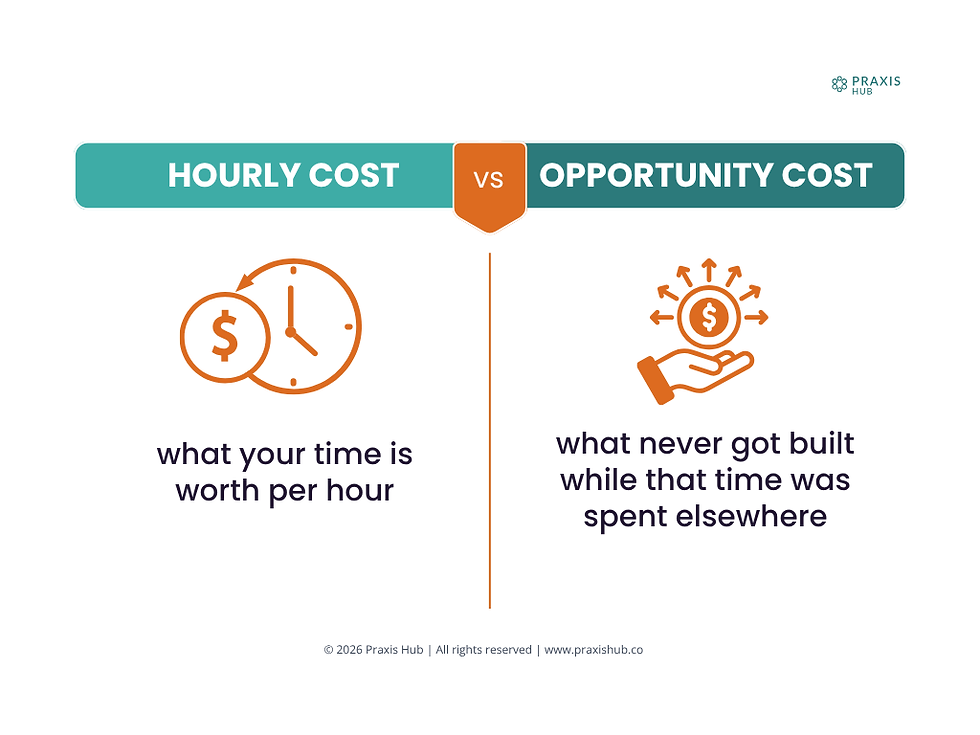
This is the distinction that gets missed. Hourly-rate math asks what an owner's time is worth per hour. Opportunity cost asks what did not get built while that time went somewhere else. The second question is almost always the more expensive one, and it is the one most owners never run.
Why Outside Perspective Helps
You cannot see clearly what you built and live inside every day. That is not a failure of intelligence. It is a structural limitation. The owner who is closest to the business is, by definition, the person least able to spot where their own presence has become the constraint.
This is also where a well-meaning shortcut tends to backfire. An AI tool, a template, or an assistant can document what an owner describes about their business. What none of them can do is see what the owner left out, the risk nobody flagged because nobody knew to flag it, or the handoff that looks fine on paper and breaks the first time it is actually tested under pressure. Outside perspective backed by real operational experience finds in days what an owner has been circling for years, because it is not trying to document the business the owner describes. It is looking for what the owner cannot see from where they are standing. Building that outside structure without adding headcount is the specific work of Delegate Without Hiring.

Free Resource: CEO Time Audit
If any of this sounds familiar, the first useful step is not a bigger fix. It is an honest look at where the hours are actually going now. The CEO Time Audit walks through a week of your calendar and flags which of those hours are decisions only you can make, and which ones are decisions someone else already could be making if the structure existed to let them.
Get the CEO Time Audit: see where your hours are actually going

Frequently Asked Questions
What is the real cost of staying the bottleneck in a growing business?
The real cost of staying the bottleneck is not measured in hours spent on the wrong tasks. It is measured in the higher-leverage work that never happens because the owner's time is tied up in decisions someone else could be making. That includes delayed hires, unpursued partnerships, and growth initiatives that stay ideas instead of becoming revenue.
How do I know if I am the bottleneck in my own business?
Common signs include every decision above a small dollar threshold routing back to you, a team that defaults to "let me check" instead of acting, finished work that sits waiting on your review, and new hires who take longer than expected to become productive because processes exist only in your head rather than in a system anyone can follow.
Is being the bottleneck a sign of poor leadership?
No. It is usually a sign that the business grew faster than the leadership structure did. Most owners who become the bottleneck built something that worked well at a smaller scale. The habits that built the business are frequently the same habits that later constrain it, and that shift is difficult to see from the inside.
Why does working longer hours not fix the bottleneck problem?
Working longer hours adds more of the owner's time to the same constrained system. It does not change the fact that decisions still route through one person. Research on entrepreneurial delegation shows that founders with strong delegation skills grow faster and generate more revenue than founders with weak delegation skills, regardless of hours worked.
What is the difference between hourly cost and opportunity cost when it comes to being the bottleneck?
Hourly cost asks what an owner's time is worth per hour spent on lower-value tasks. Opportunity cost asks what did not get built, sold, or launched because that time was unavailable for higher-leverage work. Opportunity cost is almost always the larger number, and it is the one most owners never calculate.
Ready to Find Out What Staying the Bottleneck Is Actually Costing You?
You do not need to overhaul everything at once. You need an honest look at where your time goes and what it would take to build a business that does not depend entirely on you to keep moving. Book a discovery call to talk through what that could look like for your business.
The Back Office Brief
Get a weekly insight connecting back office operations to profit. Delivered every week, free.



Comments