
Made in USA Claims: Proof and Visibility Decide Whether the Label Pays

If your product is made here, the Made in USA label is supposed to earn back the higher cost of making it here. A 2022 Retail Brew/Harris Poll survey found that nearly half of respondents said they would pay about 10 to 20% more for American-made products. Stated intent is not a sale, but it is the premium you are competing for.
What the Label Earns and What It Costs
A Made in USA label is a sales proposition, not a decoration. It tells a buyer why your product deserves a higher price than the import listed next to it. Price becomes the whole conversation when the proposition cannot be proven or cannot be found.

The premium reaches your cash flow under two conditions: the buyer can find the claim, and you can prove it. Both now run through the back office, where the records, approvals, and supplier files behind every claim live. In a report from Columbia Law School's Center for Law and the Economy, an Amazon shopping assistant told researchers it had no access to data on American-made fly-fishing reels, then listed them after a small change in wording. A label without proof can expose a company to civil penalties under the FTC's Made in USA Labeling Rule, up to $53,088 per violation, per day, according to the report.
Proving it means meeting a specific standard. According to the FTC, an unqualified claim on a label requires final assembly or processing in the United States, all significant processing in the United States, and all or virtually all components made and sourced here.
The rule covers labels, and claims outside it fall under Section 5 of the FTC Act. Whether a given listing counts as a label, and how violations are counted, are questions for an attorney, but a large catalog gives those questions room. The FTC is not the only party that can ask for proof. The Columbia report notes that state attorneys general, competitors, and in many states consumers may bring their own claims.
Made in USA Claims Meet AI Shopping Agents
Agentic AI is the term for shopping assistants that act with limited supervision: they compare products, choose one, and sometimes place it in the cart. As shoppers hand the search to agents, the agent decides what gets compared.
The researchers tested Amazon's Alexa for Shopping and Walmart's Sparky. They report that both assistants could spot listings titled Made in USA but marked as imported, and that Walmart's could judge whether an origin claim looked credible. They add that Amazon's assistant refused origin queries phrased as Made in USA while answering comparable ones. They also found that neither marketplace offers an origin filter.
These are researchers' findings, not a regulator's conclusions. Reuters reported that an Amazon spokesperson called the claim that it withholds origin information on purpose wrong, and said the assistant points origin questions to product detail pages. The report itself notes that chatbot answers are probably not official company statements.
The lesson for a manufacturer holds either way. An agent reads fields, not intentions. It reads the title, the origin field, the materials, and the supplier details, and it notices when they disagree. When it cannot find or trust your origin claim, what is left to compare is price and ratings.

The Claim Breaks Between Departments
The pattern: made in USA claims tend to break in the handoffs, not at the factory. The people who know the truth and the people who publish the claim never share a record. It tends to look like this:
Marketing writes the title, whoever uploads the data fills in the origin field, and the supplier certificate sits in a purchasing inbox.
A supplier changes where a component comes from, and nobody tells the person who maintains the listing.
One product appears on three channels with three titles, each edited by a different person at a different time.
Listing copy gets drafted or rewritten by software, and no one checks it against the bill of materials.
No one owns the question "can we prove this?", so the answer depends on who happens to be asked.
Approvals happen in conversation, so no record shows who signed off or on what evidence.
Each item looks small. Together they leave the company unable to answer a regulator, a competitor, or an AI agent quickly. Slow answers cost cash flow before any penalty arrives: senior hours spent reconstructing proof, paused listings, and revenue waiting on the answer.
The Proximity Problem
The people closest to a listing process are the least able to see its gaps. That is not a competence gap. It is physics. Whoever built the system and runs it stops questioning it. The gap is never in what the owner knows. It is always in what the owner has stopped questioning.
Asking AI to review the process does not solve this. AI documents what you describe. It cannot see what you left out, so a clean review can miss the supplier change nobody mentioned. Output that looks complete and hides a risk creates confidence without protection.
What Holds Up When Someone Asks for Proof
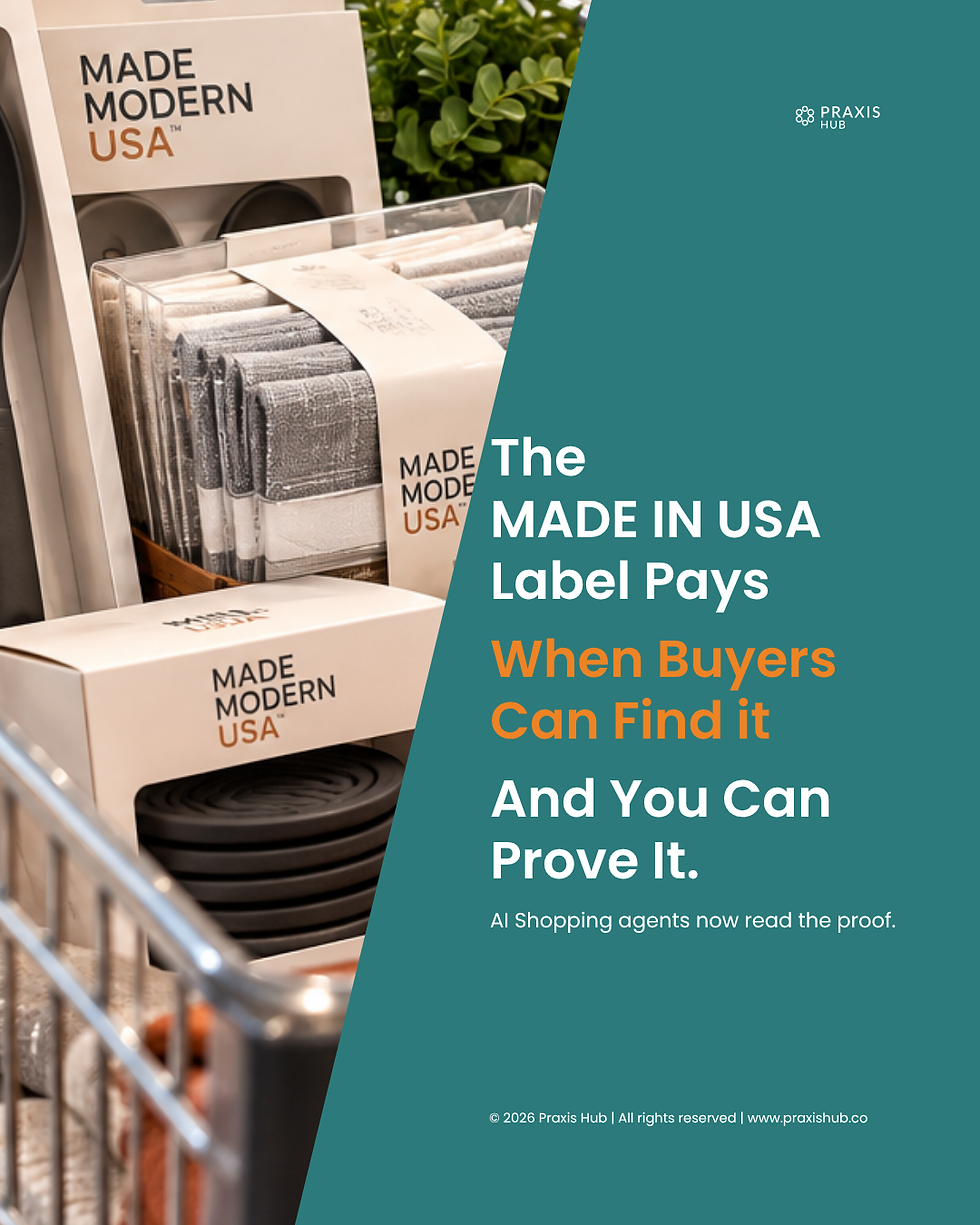
Companies whose origin claims hold up share a pattern. Someone owns each claim by name. The evidence behind it stays current as suppliers change. The listing and the records are read side by side before anything goes live. All of it depends on seeing the chain from supplier to storefront in one view.
That view is the work of back office process improvement: finding where a claim and its evidence part ways, putting a dollar figure on the gap, and building the ownership that keeps it closed. Proof is part of the product. Revenue comes from the front office. Cash flow is protected in the back office.
AI does not fix broken processes. It amplifies them, and shopping agents now read the results at machine speed. It is the same reason AI implementation results depend on the back office across industries.
Free Resource: AI Readiness Assessment
Before an AI agent reads your catalog, it pays to know where you stand. The AI Readiness Assessment is a free 7-minute self-assessment that shows where your business stands with AI, what is holding it back, and what to fix before investing in tools.

Frequently Asked Questions
Which made in USA claims need to meet the FTC standard?
Any unqualified claim, such as Made in USA or American-made. The FTC's Labeling Rule covers labels, and its policy statement applies the same all or virtually all standard to advertising and digital marketing. Claims that spell out domestic content follow different rules, so an attorney should confirm where a specific product stands.
What is agentic AI in online shopping?
Agentic AI refers to assistants that act with limited supervision. In retail, an agent can compare products, rank them on price or reviews, choose one, and place it in a cart. The Columbia report calls it a marketing term.
Does an imported label elsewhere on a listing fix a misleading title?
Generally no. The Columbia report notes, citing FTC deception policy, that a disclosure in one part of a listing does not excuse a misleading claim elsewhere if a substantial body of consumers would still be misled. Whether a specific listing is covered is a legal question for an attorney.
Who can challenge a false origin claim?
According to the Columbia report, the FTC can seek civil penalties of up to $53,088 per violation, per day, of its Made in USA Labeling Rule, and state attorneys general, competitors under federal false-designation-of-origin law, and consumers under many state statutes may also bring claims.
What does protecting a Made in USA claim have to do with the back office?
The label is only as valuable as the proof behind it. Supplier evidence, listing approvals, and change tracking all live in the back office, and gaps there turn into delays, paused listings, and penalties. An outside review reads the whole chain and puts a dollar figure on any gap.
Find Out Whether Your Claim Would Hold Up
A discovery call looks at how your product claims, supplier records, and listings connect today. You leave with something useful whether or not we work together: a first read on where your claim and its evidence part ways. Book a Discovery Call
The Back Office Brief
Get a weekly insight connecting back office operations to profit. Delivered every week, free.


Comments