
Process Improvement System: The Work You Did Is Only as Good as What You Kept

There is a reason the best cooks in any family are also the most disciplined about storing what is left. A well-made Thanksgiving meal does not end at the table. It feeds the family again on Friday. And Saturday. Sometimes Sunday. But only if someone had the discipline to put the right things in the right containers before the night was over. Leave it on the counter and by morning it is gone.
Business operations work the same way. The improvement work gets done. The team works through the problems. Something important gets fixed. And then, slowly, it drifts back. The work was not wrong. What was missing was a process improvement system to hold the output in place long enough for it to become the new standard.
Table of Contents
What Operational Drift Actually Looks Like
Most companies have done improvement work. They brought in outside help, or a senior leader drove a project, or the team spent real time working through a problem. Something got better. Standards were documented. Accountability was assigned. For a period, things held.
Then a manager left. Or a process owner got pulled to a new initiative. Or the organization moved to the next problem before the last one was fully locked in. The written procedures sat in a shared folder no one opened. The accountability structure lost its teeth. Within two quarters, the team was back where it started, treating the same problem as if it had never been addressed.
This pattern does not show up only at the ownership level. It shows up wherever someone with responsibility over a process moves on, loses authority, or simply stops reinforcing what was put in place. Operations managers, department heads, project leads. The pattern is not about the person. It is about whether a system existed to hold the work after the person stepped away.
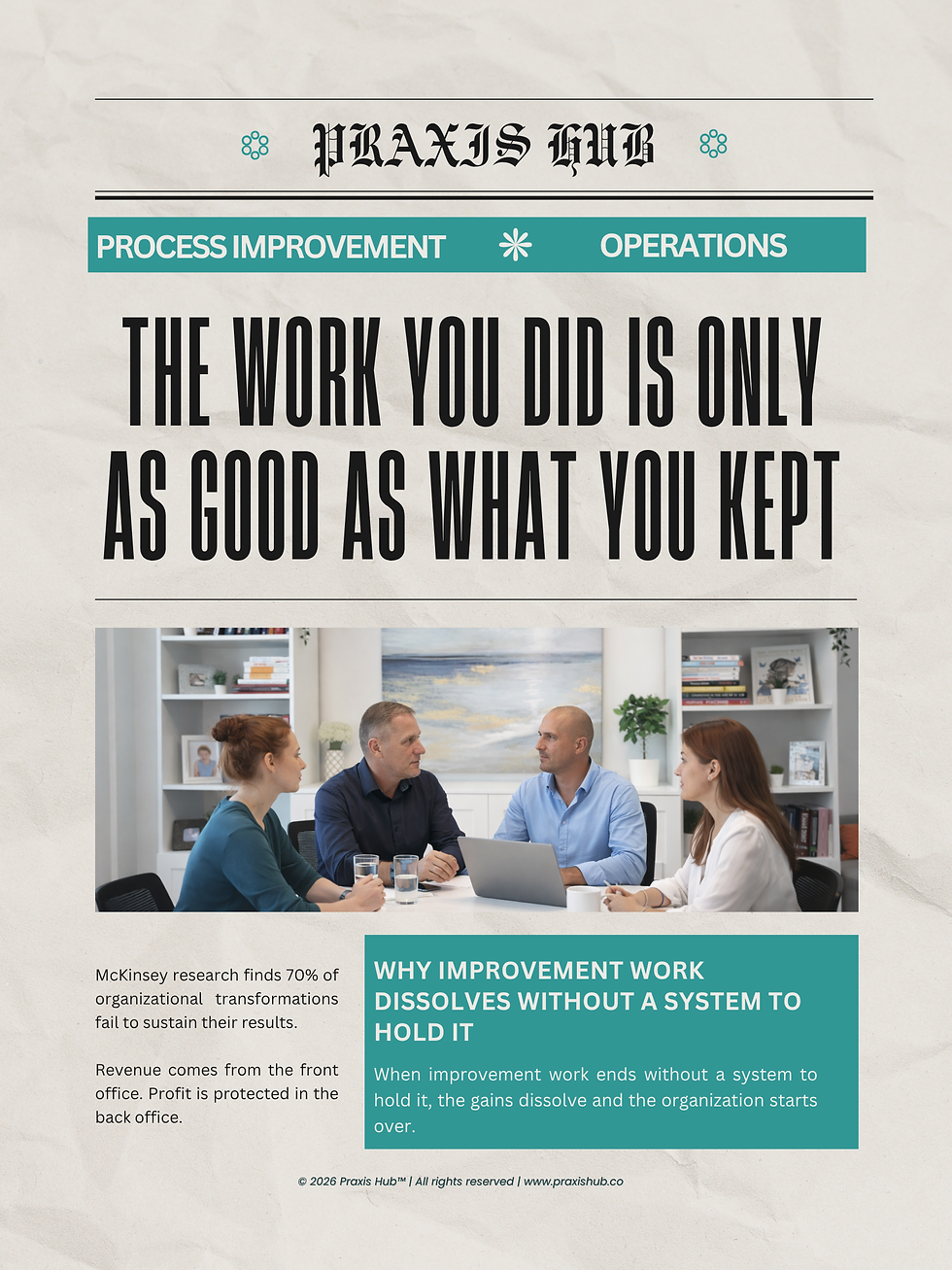
McKinsey research on organizational transformation finds that seventy percent of transformations fail, with insufficient investment in sustaining the change cited as a consistent contributing factor. The implementation succeeds. The sustainability fails. The gap is not in the quality of the fix. It is in the absence of a structure to protect it.
Why the Work Disappears
The short answer is that improvement work without a process improvement system is a one-time event. It produces an outcome. It does not produce a structure. And outcomes, without structure behind them, are temporary.
When an organization completes an improvement project, it typically ends with documentation. A revised procedure. A new accountability matrix. An updated workflow. These are artifacts of the work. They are not the system. A system is what governs how those artifacts are maintained, who is responsible for enforcing them, how new team members are trained to them, and what happens when conditions change and the process needs to be updated.
Without that, the documentation ages. The team reverts to the methods they know. New employees are trained informally by whoever trained them. The original problem resurfaces under a slightly different name and the organization treats it as a new problem. The work that was done disappears not because the team ignored it, but because there was nothing keeping it alive.
The Financial Cost of Starting Over
Every round of improvement work that does not hold is a sunk cost. The hours invested in diagnosing the problem, documenting the fix, and rolling it out to the team produced a temporary result. The organization paid for a permanent solution and received a temporary one. That is a specific financial consequence, not a general observation.
The more measurable version is this: when an organization starts the same improvement project twice, it pays twice. The second engagement carries the cost of the first plus the cost of the drift period in between, which includes the ongoing financial damage of the original problem continuing to operate unchecked.
Revenue comes from the front office. Profit is protected in the back office. When back office improvement work dissolves before it compounds, the front office keeps generating revenue that the back office cannot protect. Better processes, implemented and then lost, do not produce a better income statement. They produce a more expensive one.

The organizations that build lasting operational advantage are the ones where improvement work compounds. Each engagement builds on the last. Standards do not drift back. Documentation is treated as a living system, not a project deliverable. The operational infrastructure gets stronger over time instead of resetting. That compounding is what separates a business that has done improvement work from a business that runs on a process improvement system.
What a Process Improvement System Actually Does
A process improvement system is the structure that makes the work hold. It governs not just how processes are documented, but how they are owned, maintained, updated, communicated to new team members, and measured over time.
This is the distinction between a project and a system. A project has a start date and an end date. A system has owners and accountability structures that operate continuously. The Thanksgiving meal gets made once a year. What produces a second meal on Friday is not another Thanksgiving. It is the habit and discipline of proper storage. In operations, that habit is a process improvement system.
What this looks like in practice varies by organization, but the structural elements that consistently determine whether work holds share a common pattern:
Documented ownership assigned to every core process, not to a role that depends on a single person staying in that seat
A defined mechanism for identifying when a process has drifted, including early indicators that do not require the problem to be fully visible before action is taken
A maintenance and review cycle that treats process documentation as a living asset rather than a project deliverable filed at close
A training pathway that brings new team members into established standards rather than relying on informal knowledge transfer from whoever is available
A measurement layer that connects process performance to financial outcomes so that drift registers on the income statement, not just in operational observation
The organizations that build this consistently are the ones where improvement work compounds over time. For a starting-point assessment of where this structure is missing, the Business Process Improvement work at Praxis Hub begins with exactly that inventory.

Why This Gap Cannot Be Closed from the Inside
The most consistent obstacle to building a durable process improvement system is not a lack of willingness. It is proximity. The leadership team that built the current operations lives inside them. They know the workarounds because they created them. They have stopped questioning the inefficiencies because those inefficiencies became familiar. This is not a failure of intelligence or effort. It is a structural limitation that applies to any organization operating in close proximity to its own systems.
The team that ran the last improvement project is not well-positioned to assess whether the system held. They are too close to the result to see the drift. They will often confirm that things are working better than the operational data would suggest, because they are measuring against the problem they remember rather than the standard they set. The assessment requires distance that the internal team cannot manufacture.
This is where the value of outside perspective is direct and specific. An experienced operational eye sees what has drifted, what was never fully locked in, and what the internal team has stopped questioning because they built it. That is not a criticism of the team. It is the structural argument for why a process improvement system, and the ongoing stewardship of it, benefits from someone who did not build the organization they are looking at.
Free Resource: System Leak Audit
If improvement work has come and gone without lasting results, the question worth asking is where the system is leaking. The System Leak Audit at Praxis Hub identifies the five categories where operational work most commonly dissolves: process ownership, documentation integrity, accountability structure, training pathways, and measurement. It is a starting point, not a solution, but it will show you where the gaps are.

Get the System Leak Audit and see where your business stands. It is free, takes less than fifteen minutes, and gives you a clearer picture of what is holding and what is not.
Ready to Build a Process Improvement System That Holds?
The audit will show you where the gaps are. The discovery call is where we talk through what closing them actually looks like for your organization.
Book a free discovery call at praxishub.co. It is thirty minutes of outside perspective on what your operations show, with no obligation and no pitch. Just a direct conversation about what is working, what is not, and what a process improvement system built for your business would make possible.
Frequently Asked Questions
What is a process improvement system and how is it different from a process improvement project?
A process improvement project is a defined engagement with a start and end date. It diagnoses a problem and produces a fix. A process improvement system is the ongoing structure that governs how processes are owned, maintained, updated, and enforced across the organization. The project produces the work. The system is what makes the work hold. Most organizations invest in the project and skip the system, which is why the same problems tend to resurface.
Why do operational improvements drift back even after the work was done correctly?
Improvements drift when the output of the work — the documentation, the new standards, the revised workflows — is treated as a project deliverable rather than a live operational asset. Without a defined owner, a maintenance cycle, and a training path for new team members, documentation ages and informal workarounds fill the gap. The team reverts to what they know because the system that was supposed to hold the new standard was never built.
How does the absence of a process improvement system show up on the income statement?
When improvement work dissolves before it compounds, the organization pays for results it does not keep. The cost of the original engagement, the disruption to operations during the project, and the labor involved in implementation produce a temporary outcome rather than a permanent return. The financial damage of the original process problem continues through the drift period. Organizations that cycle through the same improvement work repeatedly are carrying the cost of that cycle without building equity in the result.
Can a company build a process improvement system without outside help?
The operational mechanics are not the primary barrier. The barrier is proximity. Leaders inside the organization have stopped questioning the processes they built and live inside. They cannot see the drift clearly because they are inside it. A process improvement system built entirely from the inside tends to reflect the blind spots of the people who built it rather than closing them. Outside perspective is not about expertise the internal team lacks. It is about the structural distance required to see what the internal team cannot.
What is the first step for a company that has done improvement work before but has not seen it hold?
The starting point is an honest inventory of what is currently held in documented systems versus what is held in people's memories and informal habits. That gap is where the risk lives and where the financial consequences accumulate. The System Leak Audit at praxishub.co/system-leak-audit covers the five categories where operational work most commonly dissolves and gives leadership a starting picture of where the gaps are before any other work begins.
The Back Office Brief
Get a weekly insight connecting back office operations to profit. Delivered every week, free.



Comments