
The Juice Was on the Property. Nobody Built the System to Sell It. The Missed Revenue Opportunity in Small Business

I was standing at a farm stand counter recently, watching customers walk up, look at the refrigerator full of pre-bottled juice, and walk away. The citrus was grown on the property. The foot traffic was real. A new residential development nearby was adding hundreds of households to the market. And six feet from where customers were standing, there was no machine, no cup, no freshly squeezed anything. Just bottles.
A countertop juicer, a cup, and a price point. That is the entire gap, and it is not a capital project or a hiring decision. It is a single operational choice that nobody had sat down to make.
That is what the missed revenue opportunity in small business looks like at ground level: a back office that was never built to convert the customers already arriving.
Table of Contents
When Growth Arrives Before the Systems Do
That farm stand had more than a juice problem. There was a coffee opportunity sitting right next to it. A small machine, a few options, a morning crowd that had already made the stop. On weekdays, the operation ran a food program with real variety. On weekends, when the residential traffic from a nearby development was highest, the food program disappeared and hot dogs took its place.
Each of those is a revenue decision, and the answer belongs in operations, not marketing: what are we set up to sell, to whom, and when?
None of those questions had been answered in a structured way. The business had grown around its original model without ever stepping back to ask whether the model had kept pace with the market it was now serving.
This pattern shows up across industries. A product-based business in a high-growth corridor running the same transaction process it used at half the volume. A service business in a market that expanded around it, still staffed and priced for an earlier version of its customer base. A food and beverage operation where the product is right and the location is right, but the revenue per customer visit has never been examined as a number worth optimizing.
The external conditions are ideal. The internal infrastructure has not kept pace. And the result is not failure. It is underperformance that never announces itself, because the business is still running, still busy, still generating some revenue. What is harder to see is the revenue that walked in the door and walked out without converting.

What the Front Office Cannot Fix on Its Own
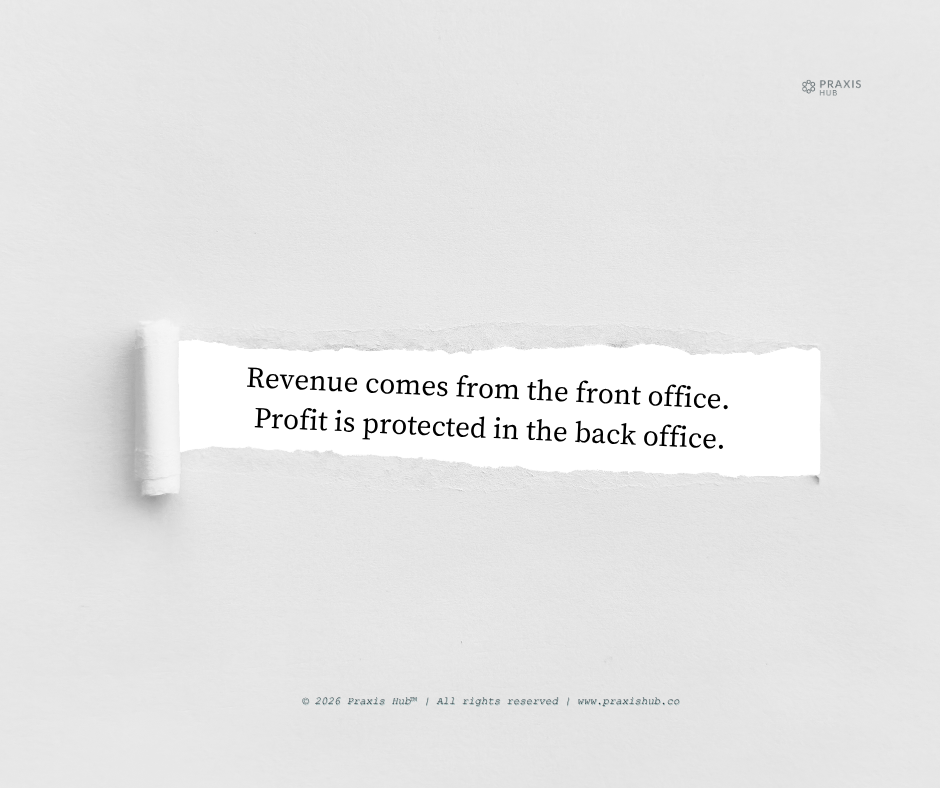
Revenue comes from the front office. The product, the customer interaction, the sale itself: all of it happens at the front of the house. When a business has strong front office elements, it can generate demand. It can create the moment where a customer is ready to buy.
What the front office cannot do is determine how much of that revenue actually becomes profit. That is back office work.
Profit is protected in the back office.
When a business has no structured process for how transactions are recorded, how product availability is tracked, how staff capacity is allocated, how reorder thresholds are set, or how demand patterns are used to make operational decisions, the front office generates activity that the back office cannot capture. Customers buy, but the margin erodes. Staff is busy, but the productivity is not measurable. Demand spikes, but the operation cannot flex to meet it.
In my 25 years of experience across industries, operational inefficiencies tend to accumulate quietly, well before they surface as a number on the income statement, which is precisely what makes them so difficult to catch from the inside.
The Gap Between Volume and Revenue
Go back to that countertop juicer for a moment. A cup of freshly squeezed juice commands a premium price point. The ingredient is already on the property. The customer is already standing there. The transaction is a 30-second decision. That single operational addition, priced correctly and staffed for the volume, represents a revenue line that does not currently exist on that income statement.
Multiply that by a coffee program. By a weekend food offering that matches the weekday menu. By a transaction process that surfaces higher-margin options instead of leaving them in the refrigerator. None of these require new customers. They require operational structure applied to the customers already present.
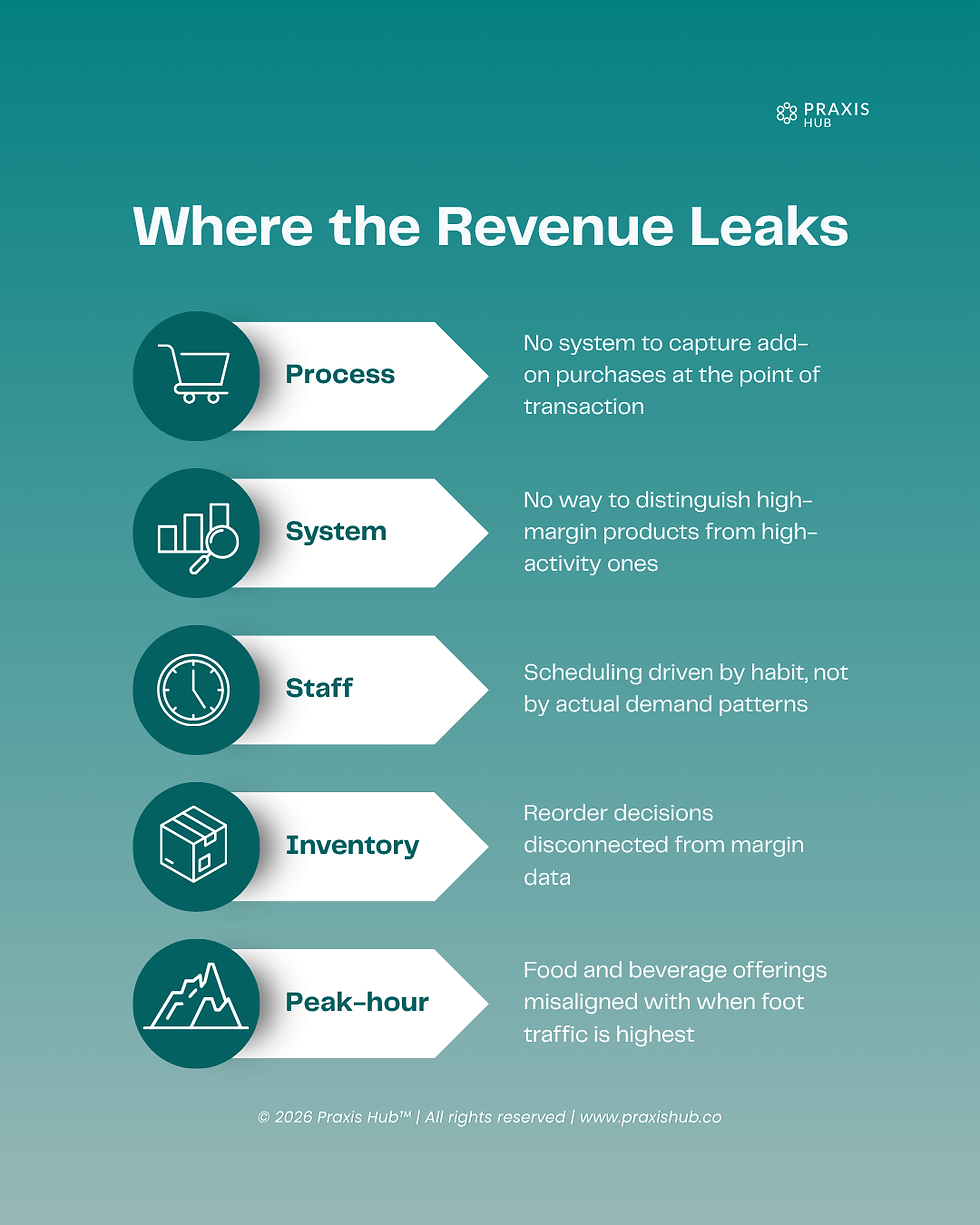
Here is what the gap looks like on the income statement. A business generates consistent customer flow. The staff is engaged. Products move. But the operational layer between that activity and the margin line is missing. Across the businesses where this pattern appears most clearly, the gaps tend to cluster in the same places:
No process for capturing add-on purchases at the point of transaction
No system distinguishing which products drive the highest margin from those that drive the most activity
Staffing decisions made by habit rather than demand pattern, leaving peak hours either overstaffed at a cost or understaffed and losing sales
Reordering and inventory decisions disconnected from margin data
Weekend and peak-hour offerings misaligned with when foot traffic is actually highest
Each of these is a small leak. Together, they represent a meaningful portion of the revenue the business was positioned to earn but did not. Gross margin compresses, revenue looks reasonable, and cost of goods or cost of service looks reasonable, but net profit does not reflect the volume. The business is working harder than its financial results suggest it should be.
This is the missed revenue opportunity in small business that rarely makes it into a founder's strategic conversation, because the founder is measuring what came in, not what was available to come in.
Why the Missed Revenue Opportunity Is Hard to See from the Inside
The businesses where this pattern is most pronounced are often the ones where the founder built everything and is still operating inside it daily. That proximity is a strength in the early stages. The founder knows every customer, every product, every vendor relationship. Nothing happens without their awareness.
That same proximity becomes a structural limitation when the business scales. You cannot see what is broken in a system you built and live inside every day. That is not a failure of intelligence. It is a structural limitation.
The operational gaps are not obvious because the business has always worked this way. The processes that made sense at lower volume are still in place at higher volume. The workarounds that were temporary became permanent. The decisions that used to live in one person's head now need to live in a documented system, but no one has built that system because the business was always too busy to stop and build it.
This is also where AI tools and automation fall short as a standalone answer. An AI tool documents what you describe. It cannot see what you left out. If the process being documented was already incomplete, the automation will be built on an incomplete foundation. The gap is never in what the founder knows. It is always in what the founder has stopped questioning.
What Back Office Structure Actually Does for Revenue
When back office operations are structured to match the volume and complexity of the business, the financial impact is measurable on the income statement. Gross margin improves because product movement is tracked and buying decisions are data-informed. Labor cost as a percentage of revenue stabilizes because scheduling reflects actual demand patterns rather than habit. Add-on revenue increases because the transaction process is designed to capture it, not leave it to chance.
None of these are front office changes. None of them require more marketing spend, a new product, or additional customer acquisition. They are the result of building operational infrastructure that is proportional to the opportunity the business is already sitting inside.
The founders who recognize this pattern are the ones who can look at a business surrounded by growth and ask a different question: what needs to be in place operationally to convert the customers we are already getting, rather than how do we acquire more of them?
That question leads to business process improvement work, not sales and marketing work. And the return on that investment shows up directly in profit, not in top-line revenue alone.
For a deeper look at what happens when businesses layer tools or automation onto operations that are not yet structured to support them, this post on buying software before fixing processes covers the financial consequence in detail.
Free Resource: 5 Steps to Streamline Your Business
If the pattern described here is recognizable, the starting point is understanding exactly where the operational gaps are and in what order to address them. The 5 Steps to Streamline Your Business guide walks through the five areas where small and mid-size businesses most commonly leave revenue on the table and what needs to happen in each one before adding more volume, more staff, or more technology.
Get the Free Guide — See where your operation stands before the next growth wave arrives.

Ready to Stop Leaving Revenue on the Table?
The businesses that convert growth into profit are not necessarily better at sales. They are better at operations. If the infrastructure behind your front office has not kept pace with the demand in front of it, a structured outside assessment is the fastest way to identify where the gaps are and what they are costing.
Start with a conversation about where your back office may be compressing your margin.
Frequently Asked Questions
What is the most common missed revenue opportunity in small business?
The most common source of missed revenue is not a lack of customers. It is the absence of operational systems to convert customer activity into consistent margin. Businesses with strong foot traffic and good products routinely underperform their financial potential when the processes behind the transaction have not been built to match the volume. The revenue arrives, but the systems to capture it cleanly do not exist.
Why does profit not increase even when sales go up?
When revenue grows but profit does not follow proportionally, the cause is almost always in the back office. Gross margin compression is the most common symptom: costs are rising in proportion to revenue, or faster, because no structured process exists to manage them. Labor inefficiency, buying decisions made on habit rather than data, and untracked product movement all contribute to a gap between what the business earns and what it keeps.
Can a business owner identify their own operational gaps?
In most cases, no, and it is not a matter of capability. Founders who built their business and operate inside it daily have genuine knowledge of how things work. What they cannot easily see is which processes are creating structural limitations, because those processes have become invisible through familiarity. Outside perspective is not a critique of the founder's knowledge. It addresses a proximity issue that is structural, not personal.
How does back office structure connect to revenue?
Back office structure determines how much of the revenue the front office generates actually reaches the bottom line. Unstructured operations create friction at the transaction level, in staffing, in inventory, in financial reporting, and in decision-making. Each friction point is a place where revenue leaks before it becomes profit. Structured operations reduce that friction and improve the conversion rate from gross revenue to net margin.
When is the right time to invest in business process improvement?
The right time is before the next growth wave, not after it. Businesses that are already experiencing strong demand have the most to gain from operational structure because the volume to monetize is already present. Waiting until growth slows down or until a visible problem forces action means the revenue that could have been captured during the growth period was already lost.
The Back Office Brief
Get a weekly insight connecting back office operations to profit. Delivered every week, free.



Comments