
Cash Flow Overtakes Inflation As Top Concern For Business Owners

Most business owners expect to worry about the economy. Fewer expect the thing that keeps them up at night to be their own bank balance. New national data confirms that shift is already here, and it says more about how businesses are built than about the economy itself.
Table of Contents
The 2026 Data Behind This Shift
A new small business lending survey found that cash flow has passed inflation as the single biggest concern among business owners for the first time. According to a press release from Enova International, the parent company of OnDeck, 31 percent of surveyed owners named cash flow their top worry, just ahead of inflation at 29 percent. The same report found that 93 percent of owners expect growth this year, and 32 percent expect significant growth, a survey all-time high.
The optimism and the anxiety are not contradictory. They are the same story told from two different angles. Owners feel good about demand. What worries them is what happens to the money once a sale closes.
What Front Office and Back Office Actually Mean
Every business runs on two engines. The front office is the revenue engine: marketing, sales, and customer acquisition. The back office is the profit and cash protection engine: billing, invoicing, collections, and the internal processes that decide how much of what the front office earns actually turns into money in the bank.
Revenue comes from the front office. Cash flow is protected in the back office.
Most business advice lives on the front office side. More leads. More marketing. More growth. The new survey data points somewhere else entirely. Owners are not worried about demand. They are worried about what happens to the money once the sale is made.
Why Growth Is Making the Gap Worse
Growth without a strong back office does not create more profit. It creates more exposure. When a business takes on more customers, more orders, or more contracts, it usually pays for labor, materials, and overhead before the customer ever pays the invoice. That timing gap is where cash flow anxiety lives.
This shows up in a handful of predictable patterns across growing businesses:
Invoices go out late because nobody owns the billing calendar
Payment terms are set once and never revisited as the client base grows
Collections follow-up happens only when cash gets tight, not on a schedule
One or two large clients carry a disproportionate share of revenue
Every new client gets custom terms instead of a repeatable process
None of this means the business is doing something wrong. It means the back office was built for a smaller, simpler version of the business and never got rebuilt as the business grew. A 93 percent growth expectation on top of an unrebuilt back office is not good news by itself. It is pressure on a system that was never designed to carry it. We have written before about how weak financial controls quietly put growing businesses at risk, and the same gaps that expose a business to fraud are usually the ones slowing down its cash.

Cash Flow Overtakes Inflation As Top Concern For a Structural Reason
Inflation is something that happens to a business from the outside. Cash flow is something that happens inside the business, and it is the one number leadership can actually influence. That distinction is likely why cash flow overtakes inflation as top concern the moment growth accelerates.
A slow month end close means leadership is making decisions on numbers that are already weeks old. A billing process with no owner means invoices sit until someone happens to notice. Accounts receivable that nobody tracks means money the business already earned is simply aging, unclaimed, in a spreadsheet or an inbox. Each of these is a back office pattern with a specific dollar amount attached to it, even when nobody has calculated what that number is.
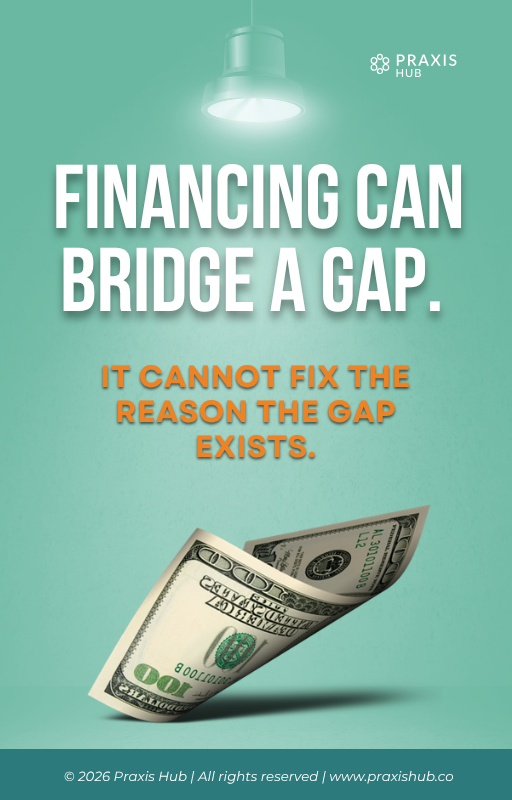
The same report found that 76 percent of small businesses now bypass traditional banks for capital, a survey all-time high. That is worth sitting with. A growing share of business owners are solving a cash flow problem by shopping for faster financing instead of asking why the cash is not showing up on time in the first place. Financing can bridge a gap. It cannot fix the reason the gap exists.
Why You Cannot See This From Inside
You cannot see clearly what you built and live inside every day. That is not a failure of intelligence. It is a structural limitation. Every hour spent running the business is an hour not spent stepping back to examine the billing cycle, the collections process, or the terms being offered to a client base that has changed since those terms were written.
AI documents what you describe. It cannot see what you left out. A tool can organize your invoicing process exactly as it exists today. It cannot tell you that the process itself is the reason cash is arriving late, because that judgment depends on having seen the pattern before, in enough businesses, to recognize it on sight. This is the specific gap Business Process Improvement work is built to close: diagnosing what is actually broken before anything gets automated or replaced.
Free Resource: 5 Steps to Streamline Your Business
If any of this sounds like your business, the place to start is not a bigger financing line. It is a clear look at where the back office is quietly setting the pace for your cash position. The 5 Steps to Streamline Your Business guide walks through how to identify and fix the operational gaps that are already costing you, before adding new tools on top of them.

Frequently Asked Questions
Why does cash flow overtake inflation as a top concern for business owners?
Inflation affects every business the same way from the outside. Cash flow is shaped by internal decisions: billing cycles, payment terms, and collections follow-up. As businesses grow, those internal systems come under more pressure, which is likely why cash flow overtakes inflation as top concern once growth accelerates.
Is strong growth a guarantee of strong cash flow?
No. Growth increases the volume moving through a business, including invoices, collections, and vendor payments. Without a back office built to handle that volume, growth can widen the gap between revenue earned and cash actually collected.
What is the difference between a revenue problem and a cash flow problem?
A revenue problem means not enough sales are coming in. A cash flow problem means sales are coming in, but the money from those sales is delayed by billing timing, payment terms, or collections gaps. Many growing businesses have a cash flow problem, not a revenue problem.
Why do more business owners now bypass traditional banks for financing?
According to the same industry data, faster access to capital and more flexible terms are driving business owners toward non-bank financing options. This addresses the symptom of a cash flow gap. It does not address why the gap exists in the first place.
Can a business owner fix back office cash flow issues without outside help?
Business owners can absolutely take first steps on their own. What is harder to do alone is seeing the full pattern from inside a system you built and operate every day. Outside perspective, backed by operational and financial experience, tends to find in days what an owner has been circling for months.
Ready to See Where Your Cash Flow Is Actually Going?
A Process Health Check gives you a clear, outside look at where your back office is creating the cash flow pressure you are feeling, and what it would take to close that gap. Book a discovery call to talk through what that would look like for your business.
The Back Office Brief
Get a weekly insight connecting back office operations to profit. Delivered every week, free.



Comments