
Back Office Profit Leakage: What Is Costing Your Business More Than You Realize


Most growing businesses are not underpowered in the front office. They are leaking in the back. Revenue comes in, the team is working, the calendar stays full, and yet the margin never reflects the effort. That is not a sales problem. That is profit leakage from the back office, and it is one of the most expensive patterns a business can carry without ever seeing a line item for it.
According to McKinsey's State of Organizations report, two-thirds of business leaders identified their organizations as overly complex and inefficient. These were not struggling companies. They were active, functioning organizations with leadership in place, still losing ground to problems embedded in their own systems.
Table of Contents
What Back Office Profit Leakage Actually Means
Back office profit leakage is not a single event. It is not one bad hire, one missed invoice, or one broken workflow. It is the accumulated cost of systems that were built quickly, never revisited, and are now running in the background of a growing business, quietly taxing every dollar the front office generates.
The back office covers everything that happens after the sale: billing and collections, vendor management, payroll, reporting, compliance, onboarding, approvals, and the internal handoffs that keep the business operational day to day. When those systems are misaligned, undocumented, or duplicated, the business pays for it: rework, delays, overtime hours, and decisions made on incomplete information.
Revenue comes from the front office. Profit is protected in the back office. When the back office is not functioning as a protective system, the gap between what the business earns and what it actually keeps widens with every new client, every new team member, and every new service line added.
That is the leakage pattern. It does not look like a crisis. It looks like overhead.
Where the Money Goes Unnoticed
The most costly operational problems are the ones that have been normalized. They do not trigger an alarm because the business adapted around them. The financial consequence of each one is real: labor hours that produce rework instead of output, invoices that go out late and compress working capital, institutional knowledge that walks out the door with every departure, and owner time redirected to decisions that should not require it. These are not edge cases. In my experience across different industries, this is what a margin problem looks like from the inside.
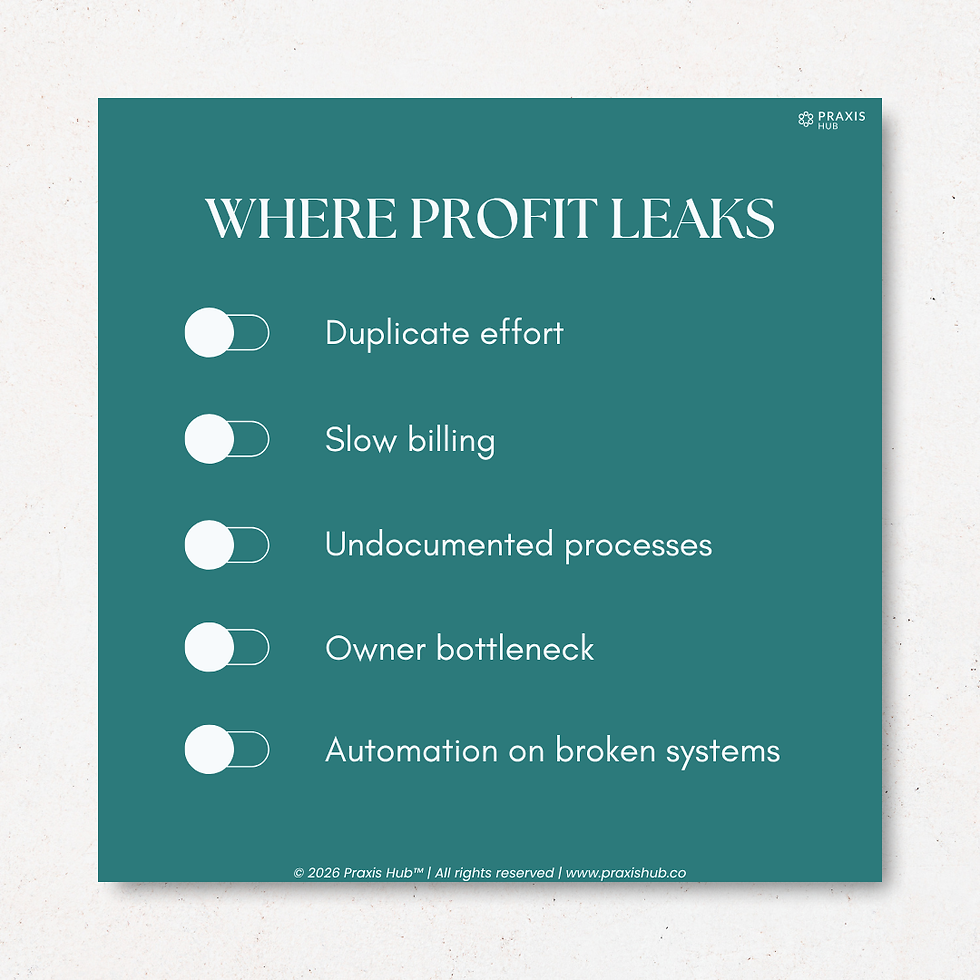
The patterns that show up most consistently:
Duplicate effort and unclear task ownership, where everyone touches the work partially and no one completes it
Slow or inconsistent billing that turns earned revenue into a cash flow problem
Undocumented processes that make every personnel change a partial shutdown
Approval bottlenecks that route decisions to the owner that the team should be making
Automation layered on top of broken processes, which accelerates the problem rather than solving it
Process cleanup is how you stop paying for waste. Automation is how you scale. That sequence matters, and most businesses have it reversed. None of these patterns are rare. In my experience across different industries, at least three of the five are present in every business that walks in with a margin problem. The owner is rarely surprised by the list. What surprises them is how long it has been running.
The Real Cost: Time, Effort, and Margin
This problem is not measured in one category. It draws against three resources simultaneously: money, time, and effort. And the depletion of each one feeds the others.
The financial cost is the most visible, even if it takes work to calculate. Rework costs labor hours. Vendor contracts that have never been reviewed contain pricing that no longer reflects the current relationship. Subscription tools that no longer serve a function still renew monthly. Billing errors that go uncorrected create write-offs. None of these appear as a single large number on a report. They appear as a persistent, unexplained gap between revenue and profit.
The time cost is less visible and more damaging. Every workaround your team has built around a broken process is time borrowed from productive work. That time does not appear on a payroll report. It shows up as a ceiling on what the business can deliver without adding headcount.
The effort cost is the one that depletes the organization at the human level. When people spend their energy navigating internal friction instead of doing the work they were hired to do, engagement drops and retention follows. A leaky back office is a tax on every dollar the front office earns. It is also a tax on the people doing the work.
Why This Problem Compounds at Scale
A back office that leaks at ten employees does not self-correct at twenty. It gets louder. The same broken handoffs that cost two hours per week at one revenue level cost twelve hours per week at the next, because more transactions are running through the same broken path.
Growth does not fix operational problems. Growth amplifies them. The business that pushes for more revenue on top of a back office that is already leaking acquires customers faster than it can serve them well. Margin compresses. The team works harder and earns less. The owner cannot figure out why the business feels more difficult now than it did when it was smaller.
The answer is almost never in the front office. The answer is in the systems the business never stopped to examine, because there was always something more urgent to deal with.
That is the structural problem. The owners who built these businesses were focused on building revenue. That is rational. That is exactly what a founder is supposed to do in the early stages. The back office fell behind because the front office demanded attention. That is not a failure of discipline. It is how businesses grow. The problem is when the back office stays behind while the business keeps moving forward.
Process Improvement Is Not a Project
One of the most persistent misconceptions about operational work is that it has an end date. Organizations treat process improvement as a project: bring in an outside team, document the workflows, implement a new system, close the initiative. The back office problem is solved.
It is not solved. It is paused.
Process improvement is an operating discipline, not a deliverable. The business is not a static system. People change, services evolve, client demands shift, technology changes, and the back office must adapt continuously. A documented process that was accurate eighteen months ago is not necessarily accurate today. A control that worked at a team of twelve does not automatically scale to a team of thirty.
The businesses that protect profit over time are the ones that have built the discipline of operational review into how they run. They do not wait for something to break before they look at how it works. They treat the back office the same way they treat the front: with consistent attention, measured performance, and a standard for what good looks like.
That discipline is what prevents the next round of leakage before it starts.

You cannot see what is broken in a system you built and live inside every day. That is not a failure of intelligence. It is a structural limitation. The owner who has run the same billing process for three years has stopped questioning it, not because they are incurious. Proximity removes perspective. AI documents what you describe. It cannot see what you left out.
If you want to understand how this plays out when a business tries to fix the problem by adding technology first, the post Fix Process Before Tech covers that pattern directly.
Why Outside Perspective Matters Here
The System Leak Audit is a useful starting point precisely because it is structured to surface what the owner has normalized. It asks about five categories of operational function. Most owners who complete it find at least one area where they assumed everything was working and the audit reveals otherwise.
Once you know where the leakage is happening, the next step is to assess what you are working with. That is where the SWOT framework becomes practical.
Using SWOT Analysis to Assess What You Have to Work With
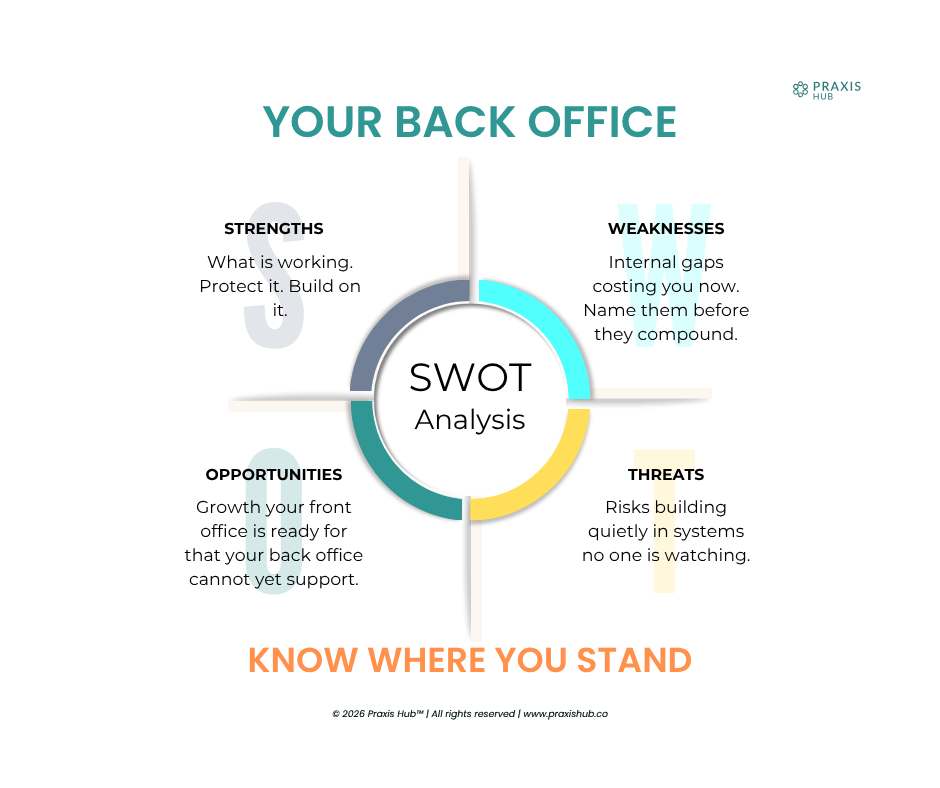
SWOT stands for Strengths, Weaknesses, Opportunities, and Threats. Most people have heard of it. Fewer apply it specifically to their back office operations, which is exactly where it does its most useful work.
The purpose of a SWOT analysis in this context is not to produce a strategy document. It is to give the business owner an honest picture of where the operation actually stands, so that decisions about where to invest time and resources are based on reality rather than assumption.
Here is how each quadrant applies to operational health.
Strengths. These are the parts of your back office that are working. Documented processes that the team follows consistently. A billing system that closes on time. A reporting structure that gives leadership accurate numbers. These are assets. The goal is to identify them clearly so they are not disrupted when other areas are being improved, and so the business knows what it can build on.
Weaknesses. These are the internal gaps that are costing the business now. An approval process that requires the owner for decisions that should not need them. A handoff between departments that breaks under pressure. A vendor relationship that has never been reviewed. Weaknesses are not failures. They are areas where the operation has not kept pace with the business's growth. Naming them is the first step to addressing them before they compound.
Opportunities. These are the gains the business is leaving on the table because the back office is not positioned to capture them. A service the team could deliver more profitably if the process behind it were tighter. A market the business could expand into if the internal structure could support the volume. Operational drag does not just cost money. It blocks growth that the front office is ready for and the back office cannot yet support.
Threats. These are the risks that are building quietly inside systems no one is actively monitoring. A compliance requirement the business is not tracking. A single employee who owns a critical process with no backup. A vendor contract that auto-renews on terms that no longer make sense. Threats do not announce themselves. They surface when the business least expects them, often at the worst possible time.
The sequence matters. Start with the System Leak Audit to find where the business is losing margin. Then use the SWOT to assess what you are working with across all four dimensions. Those two exercises together give a more complete picture of where the operation actually stands than any revenue report can provide.
Free Resource: System Leak Audit
If the patterns in this post reflect your experience, the right first step is not an overhaul. It is an honest look at where the leakage is happening.
The System Leak Audit from Praxis Hub walks you through five categories of operational function to identify where your business is losing money, time, or effort without a clear line item to show for it. It takes less time than the leakage costs you in a single week.
Frequently Asked Questions
What is back office profit leakage, and how is it different from revenue loss?
This type of profit loss is the ongoing drain on margin through internal operational inefficiencies: duplicated work, undocumented processes, slow billing, and broken approvals. Revenue loss refers to money the business failed to earn. Profit leakage refers to money the business earned but failed to keep because of how the back office processes it. The two problems require different solutions, and confusing them leads to investing in the wrong fix.
Why do growing businesses miss this type of profit leakage for so long?
Because the leakage does not look like a crisis. It looks like overhead, turnover, rework, and the persistent sense that the business is working harder than the margin reflects. Owners are trained to read revenue numbers. The back office problems that erode profit do not appear as a single line. They distribute across payroll, vendor costs, time, and operational drag, which is exactly why they go unaddressed for so long.
Is process improvement something a business can handle internally?
Internal teams can document processes, and documentation has value. But the most costly gaps in a back office are typically the ones nobody inside the business can see anymore: the workarounds that became standard, the approvals that became habitual, the tools that became redundant. Outside perspective is not about capability. It is about proximity. You cannot audit a system you are running inside.
When is the right time to address profit leakage in the back office?
Before the next growth phase. Operational problems do not self-correct at scale. A back office that leaks at ten employees will leak harder at twenty. The businesses that address the back office before they push for the next revenue target protect more of what they earn at every stage of growth.
How is the System Leak Audit different from a full operational assessment?
The System Leak Audit is a diagnostic tool, not an engagement. It covers five operational categories and surfaces the areas where your business is most likely losing margin. It is designed to give the owner enough visibility to prioritize, not to prescribe solutions. From there, the appropriate next step depends on what the audit reveals.
Ready to Talk About What Your Back Office Actually Needs?
The leakage does not stop because you are aware of it. It stops when the systems that cause it are identified and addressed. If you are ready to talk through what that looks like for your business, the discovery call is the right next step.
The Back Office Brief
Every week, The Back Office Brief delivers one insight connecting back office operations to profit — for founders running companies with 10 or more people who want to stop leaving money in broken systems. No noise. One idea. Straight to your inbox.



Comments