
AI Accountability Era: What It Means for Your Business Right Now

The scoreboard has gone up. Enterprise executives worldwide are learning that AI is no longer an experiment with unlimited runway. Results are expected, and if they don't arrive, jobs are on the line.
That pressure hasn't hit most small businesses yet. But the operational gap it exposes? It's already there, quietly costing you time and money every single week.
Table of Contents
What the Accountability Era Actually Looks Like
A new global survey from Dataiku and The Harris Poll, covering 600 Chief Information Officers across the U.S. and seven other countries, found that AI has entered a decisive new phase. Boards are no longer satisfied with pilot programs and promising demos. They want numbers.
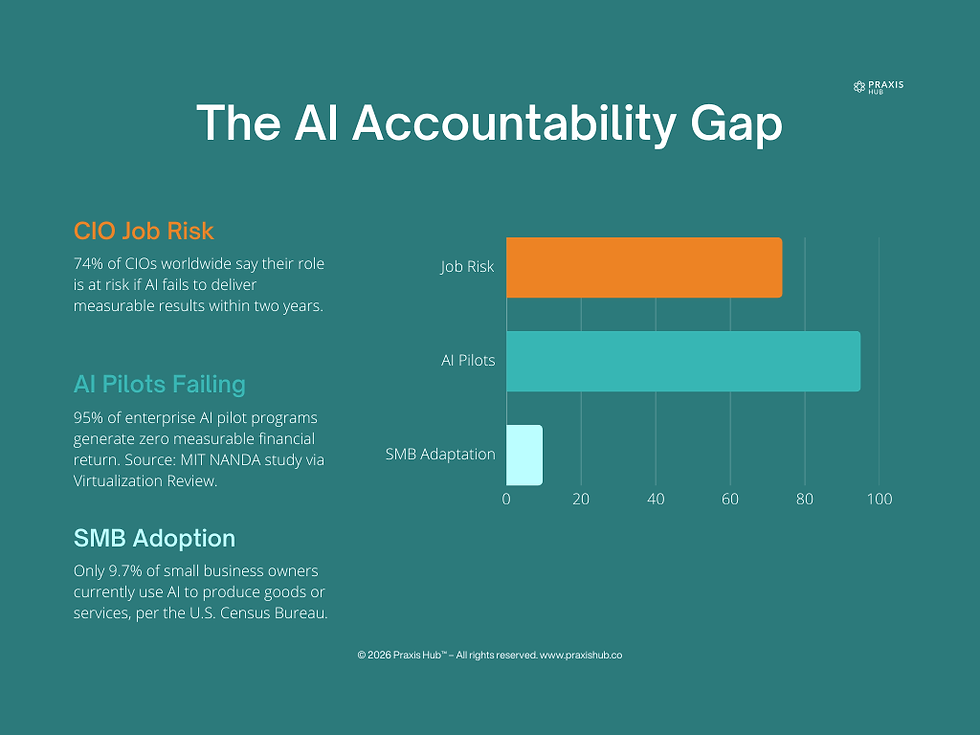
The pressure is significant. Nearly three-quarters of CIOs surveyed said their role is at risk if AI fails to deliver measurable gains within the next two years. More than 80% expect their compensation to be tied directly to AI performance outcomes. And 71% believe their AI budget will face cuts or a freeze if targets are not met by the middle of this year.
That is a tight timeline. And the phrase that the Dataiku CEO used to describe this moment is worth sitting with: AI is moving "from experimentation into accountability faster than most organizations expected."
Here's what that pattern means beyond the enterprise world.
Why 95% of AI Projects Have Delivered Nothing
Before discussing what small businesses should do, it's worth understanding why so many large organizations are struggling despite massive investment.
A July 2025 MIT NANDA initiative study, as reported by Virtualization Review, based on executive interviews, employee surveys, and analysis of 300 AI deployments, found that only 5% of AI pilot programs achieve rapid revenue acceleration. The vast majority deliver no measurable financial return at all.
The reason is not the technology. It's what sits underneath it.
MIT researchers identified what they call a "learning gap," specifically the disconnect between the capability of AI tools and the organizational readiness to actually use them. Companies trying to layer AI onto undocumented, inconsistent, or manual workflows are not getting smarter. They are getting faster at the wrong things.
The Dataiku survey reinforced this pattern. Among CIOs surveyed, 85% said gaps in traceability or explainability have already delayed or stopped AI projects from reaching production. Translation: organizations could not explain what their AI was doing or why, because the underlying processes were not documented well enough to begin with.
AI does not create structure. It requires it.
The Small Business AI Picture Is Different
While enterprise CIOs face an accountability reckoning, most small businesses have not rushed into AI adoption at all. According to the U.S. Census Bureau's Business Trends and Outlook Survey, only about 9.7% of small business owners reported using AI to produce goods or services as of September 2025, up from 3.7% when the survey launched in 2023. That is real growth, but it is still a very small share of the market.
This is not necessarily a problem. It may reflect exactly the right instinct: don't adopt a tool before you understand it or before your operations can support it.
The businesses that will be positioned to win with AI are the ones that do not rush in without preparation. They are building the foundation now.
AI Accountability Era: What It Reveals About Operations
The AI accountability era is a useful diagnostic, even for businesses that are not yet implementing AI. It surfaces questions every business owner should be asking regardless of where they stand on technology adoption.
Can you explain, in clear and specific terms, how a core process in your business actually works? Not how it is supposed to work. How it actually runs today, step by step, with clear ownership at each stage.
If the answer is "it depends" or "usually my team handles that" or "I would have to ask someone," you have a documentation gap. And that gap will show up whether you add AI or not. It shows up in onboarding, in handoffs, in client delivery, in cash flow predictability.
In 25 years across industries from Fortune 500 operations to five-person service businesses, this pattern shows up everywhere. Organizations that cannot trace how their own processes work cannot measure them, improve them, or delegate them successfully. AI does not change that equation. It accelerates it.
The businesses getting results from AI share one characteristic: they had clean operational foundations before they started. Documented processes. Clear ownership. Defined outputs at every stage. The technology was the last step, not the first one.
The Missing Role Nobody Talks About
One detail from the Dataiku research stands out for smaller organizations. Among enterprises that are succeeding with AI, line managers who are close to operations and empowered to drive adoption play a critical role. Not central IT labs. Not executive mandates. Managers who understand the day-to-day well enough to identify where technology fits and where it does not.
Most small businesses do not have that person.
The owner is usually the closest person to operations, but the owner is also running sales, handling client relationships, managing finances, and putting out fires. There is no bandwidth left to think strategically about which processes need fixing and in what order.
This is the operational gap that Delegate Without Hiring addresses. Not another employee to manage. A fractional chief of staff who functions as the operational strategist your business needs, specifically to document what exists, clarify who owns what, and build the systems that allow the business to run and scale without the owner in the middle of every decision.
That role matters at every stage, and it matters most right before technology adoption. Because the businesses that go into AI implementation with clear processes and defined ownership are the ones that land in the 5% that actually see results.
The ones that go in without that foundation tend to confirm the other 95%.
Why Outside Perspective Helps
When you are inside your business every single day, certain patterns become invisible. Not because they are not there. Because proximity creates blind spots.
This is not a competence issue. It is a structural one.
The owner who built the business from scratch is often the last person to see where the operational drag is coming from, precisely because they have adapted around it for years. They have workarounds baked into their instincts that never made it into a document, a system, or a role definition.
Outside perspective breaks that pattern. Not to criticize what exists, but to map it clearly enough that decisions about it can be made deliberately rather than reactively.
The businesses that are best positioned for what is coming, whether that is AI adoption, a key hire, or a serious scaling push, are the ones that built operational clarity before the pressure arrived. Not because of the pressure, but in spite of it.
That is a choice you can make now.
Get the free AI Readiness Assessment and see exactly where your business stands on the five factors that determine whether AI investment will deliver results or disappear into the 95%.
Frequently Asked Questions
Does the AI accountability pressure affect small businesses directly?
Not yet in the same way it hits enterprise CIOs. But the operational gaps the accountability era exposes are the same ones that limit growth, increase errors, and make scaling harder at every size. The smart move is to address those gaps before pressure arrives, not because of it.
What does "clean operational foundation" actually mean for a small business?
It means your core processes are documented, your team knows who owns each step, and you can trace what happens when something breaks or falls through the cracks. It does not require perfect systems. It requires enough clarity that the business does not depend on one person holding everything in their head.
Why would a small business need a fractional chief of staff instead of a full-time hire?
Most small businesses are not ready to support a full-time operational leader, and they do not need one consistently. What they need is the thinking and structure that role provides, at the stage and budget that actually fits. Delegate Without Hiring brings that capacity in without the overhead, the benefits, or the management burden of a full-time hire.
How long does it take to build the kind of operational foundation AI requires?
It depends on the starting point. Businesses with some documentation and defined roles can get to a solid foundation in four to eight weeks of focused work. Those starting from scratch typically need eight to twelve weeks to map processes, clarify ownership, and build systems that run without constant owner intervention. The investment pays off with or without AI.
What is the first step if I want to know where my business actually stands?
The fastest way to get clarity is to take the AI Readiness Assessment. It surfaces the five operational areas that most directly predict whether technology adoption will succeed or stall. It takes about ten minutes and does not require any technical knowledge to complete.
Ready to Know Where Your Business Actually Stands?
The AI accountability era is creating a new dividing line: businesses with operational foundations that can support results, and businesses that are not yet there.
Get the free AI Readiness Assessment and identify:
Where your operational gaps are right now
Which gaps will surface first under AI adoption pressure
Whether your business is in a position to be in the 5% that succeeds
What to fix first, before investing in any new technology
Get the AI Readiness Assessment - See where your business stands.
Or if you're ready to talk through what operational clarity could look like for your specific business, book a 30-minute Discovery Call and we'll start there.
Sources Referenced:



Comments