
Accounting Roles Small Business Owners Confuse and What It Costs Them

Someone in a business owners' group recently made a confident announcement: he had asked an AI chatbot his tax questions, gotten clear answers, and decided he no longer needed his accountant. The room nodded along. And right there, in that nod, was the problem.
What he described was not a discovery about technology. It was a gap in how accounting roles small business founders understand, and more importantly, what that gap is quietly costing them on the income statement.
Table of Contents
What Everyone Calls "The Accountant"
When a founder says "my accountant," they usually mean whoever is handling the numbers. That could be a bookkeeper entering transactions, a CPA filing returns, an internal controller managing month-end close, or an external auditor reviewing the books. In a large company, those are four different people with four different credentials, four different responsibilities, and four different lanes of authority. They are not interchangeable.
The business owner in that group did not fire his accountant. He got a general tax question answered. Those are not the same thing, and the distinction matters more than most founders realize until there is a problem to clean up.
The Three Functions That Cannot Overlap

Accounting inside a company with 10 or more employees typically falls into three separate functions. Understanding what each one does, and what each one cannot do, is the first step toward understanding why one person or one AI prompt cannot cover all three.
The first function is record-keeping, which is what bookkeepers and staff accountants handle day to day. Transactions get entered. Accounts get reconciled. Payroll gets processed. This work has real value, but it is only as accurate as the information coming in. If the processes feeding those entries are disorganized, the records reflect that disorganization.
The second function is compliance and tax strategy. This is the domain of the CPA. A Certified Public Accountant is licensed, regulated, and responsible for understanding the tax code, identifying legal obligations, and reducing tax exposure within the rules. This is not general knowledge. It is a specific credential with continuing education requirements attached to it for a reason.
The third function is oversight: internal audit, external audit, and financial controls. In a large organization, these roles exist specifically because no one should audit their own work. Even companies with entire finance departments bring in external auditors. The oversight function is structural, not a sign that something is wrong.
AI can assist with research. It can answer general questions about tax categories or explain accounting terms. What it cannot do is carry professional liability, know the specifics of your state's regulatory environment, or catch the error your bookkeeper made in March that is about to affect your Q3 close.
Accounting Roles Small Business Founders Actually Need
The honest version of this conversation is not about accountants versus technology. It is about what a company with real payroll, real vendors, and real tax obligations actually requires.
At a minimum, a growing company needs someone managing the day-to-day record-keeping, a CPA relationship for tax planning and compliance, and a regular review process that is not performed by the person doing the entering. That last piece is where most small businesses have a visible gap. The bookkeeper cannot audit the bookkeeper. The owner reviewing their own financials cannot see what they have been trained not to see.
This is not a failure of intelligence. It is a structural limitation that shows up the same way across industries and revenue levels.
Your Accounting Function Is Only as Good as the Processes Feeding It

Here is what the conversation in that business owners' group missed entirely: the question was never about the accountant. It was about the back office processes that make the accounting function useful or useless.
Revenue comes from the front office. Profit is protected in the back office. And the back office includes every process that touches a number before it reaches your financial statements: how invoices get created and sent, how expenses get categorized and approved, how receipts get matched to transactions, how month-end gets closed and by whom.
When those processes are undocumented, inconsistent, or dependent on whoever happens to handle them that week, the data entering the accounting function is unreliable. A CPA working from unreliable data can still file a compliant return, but they cannot protect profit from what they cannot see. A bookkeeper reconciling accounts built on informal workflows is reconciling a system that was never designed to be clean.
This is the part no AI prompt addresses: the operational infrastructure that either feeds accurate, timely numbers into your accounting function or produces the kind of books that generate expensive surprises at year-end. The same principle applies any time a business adds a tool or technology on top of an unexamined process, which is why fixing the process before the technology is the sequence that protects what the accounting function is supposed to produce.
The companies that discover they owe more than expected, or that their margins are not what they thought, or that they cannot get a clean audit, almost always have a back office process problem underneath the accounting question. Fixing the accounting role does not fix the process. It only makes the process's problems more visible.
Praxis Hub works with companies to identify and correct exactly these kinds of operational gaps, the ones that sit between what the business is doing and what the financial statements are actually capturing. Business Process Improvement is where that work lives.
Why Outside Perspective Matters Here
The founder who decided AI replaced his accountant was not wrong to use technology as a resource. He was missing a layer of context that is hard to see from inside your own operation.
When you build a business and manage it day to day, the way things are done stops being visible as a decision. It becomes simply the way things work. An outside perspective, whether from a CPA on your tax position or an operational advisor on your back office, sees what the owner has stopped questioning. That is a structural limitation, not a failure of intelligence.
By the time the process problem shows up on the income statement, correcting it costs significantly more than preventing it would have.
The back office does not show up on your marketing dashboard. It shows up on your income statement.
Free Resource: System Leak Audit
If you are not sure whether your back office processes are feeding clean data into your accounting function, the System Leak Audit is a practical starting point. It covers five categories of operational gaps that show up most consistently across companies with 10 or more employees.
Get the System Leak Audit and see where your operation stands before those gaps show up somewhere more expensive.

Ready to Look at What Is Feeding Your Numbers?
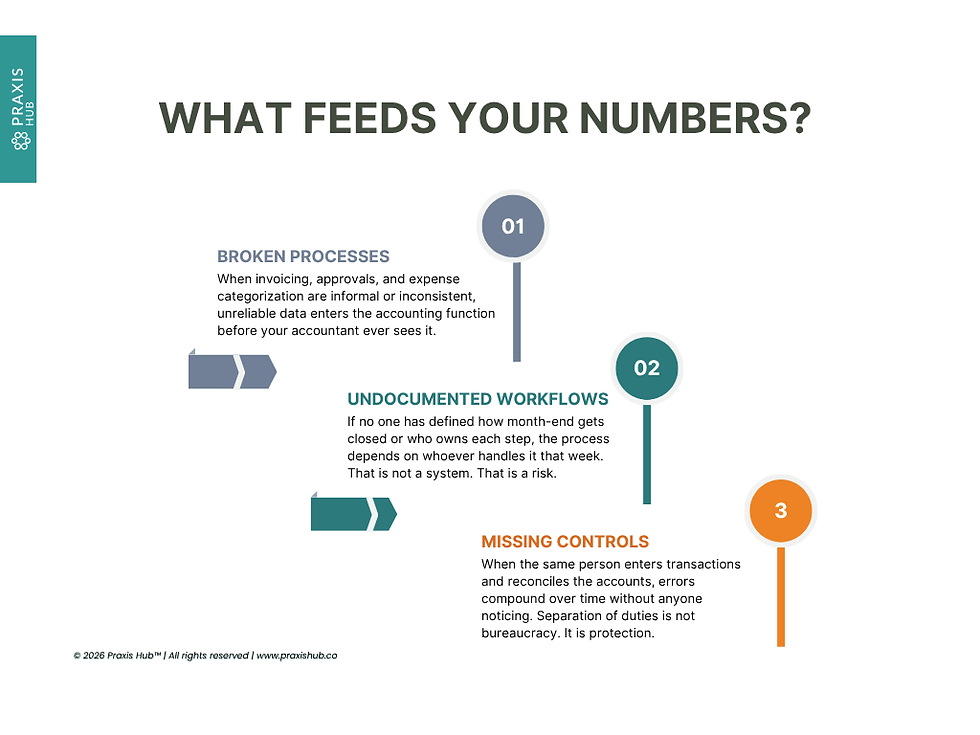
Accurate financials are a back office outcome. They depend on the processes that create the data, not just the professional reading it. If the connection between your operations and your financial statements is not as clean as it should be, that is a process conversation, not just an accounting one.
Frequently Asked Questions
What is the difference between a bookkeeper and a CPA for a small business?
A bookkeeper handles day-to-day financial record-keeping: entering transactions, reconciling accounts, managing payroll, and keeping the books current. A CPA is a licensed professional responsible for tax compliance, tax strategy, and financial reporting that carries regulatory weight. Both roles serve different functions and are not substitutes for each other. A growing company with 10 or more employees typically needs both, and they should be two separate relationships.
Can AI replace an accountant for a small business?
AI can answer general accounting and tax questions and assist with research. It cannot carry professional liability, apply knowledge of your specific state's regulatory environment, or catch errors created upstream in your back office processes. For a business with real payroll, vendor relationships, and tax obligations, an AI answer does not replace a licensed professional relationship, particularly when compliance or year-end accuracy is involved.
Why do the accounting roles small business owners hire produce different results at different companies?
The difference is almost always in the processes feeding the accounting function, not in the quality of the professional doing the work. When invoicing, expense categorization, approval workflows, and month-end procedures are inconsistent or undocumented, the data entering the accounting function is unreliable before the accountant ever sees it. Cleaning up the accounting without addressing the process produces temporary improvement at best.
Do small businesses need an internal audit function?
Not necessarily a dedicated audit role, but a business with 10 or more employees needs some form of oversight and separation of duties. No one should be both entering transactions and reconciling the accounts those transactions touch. No one should be both approving expenses and paying vendors. These structural separations are not bureaucracy. They are the controls that prevent errors and exposure from compounding over time without anyone noticing.
How do I know if my back office processes are affecting my financial accuracy?
Common indicators include financial statements that take longer to close than they should, recurring reconciliation differences that get forced rather than explained, tax surprises at year-end that were not visible in the monthly numbers, and an inability to produce clean financial reports when needed for a loan, a sale, or an investor conversation. If any of those are familiar, the issue is upstream from the accounting function itself.
The Back Office Brief
Get a weekly insight connecting back office operations to profit. Delivered every week, free.



Comments