
Why Delegation Fails: The Hidden Cost Leaders Never Talk About

Updated: Apr 29
You built the business. You grew the team. You should have more time by now, not less.
Instead, every task still crosses your desk. Every question still comes to you. Every decision still waits for your approval.
The cost of poor delegation shows up in two places most business advice ignores. The first is the income statement: slower invoicing, delayed follow-ups, stalled projects, and strategic decisions that never get made because the leader ran out of cognitive bandwidth by 2pm. The second is psychological: the invisible mental weight that accumulates when everything in a business still runs through one person. Both costs compound. And neither one fixes itself with a better to-do list.
The Weight Nobody Sees
There is a quiet frustration that comes with being the person everything runs through.
It does not show up on a spreadsheet. But every business owner who has been the decision bottleneck knows the feeling: a constant low-level tension that never fully goes away. Even after hours. Even on weekends. Even on the rare vacation when the phone stays in the drawer.
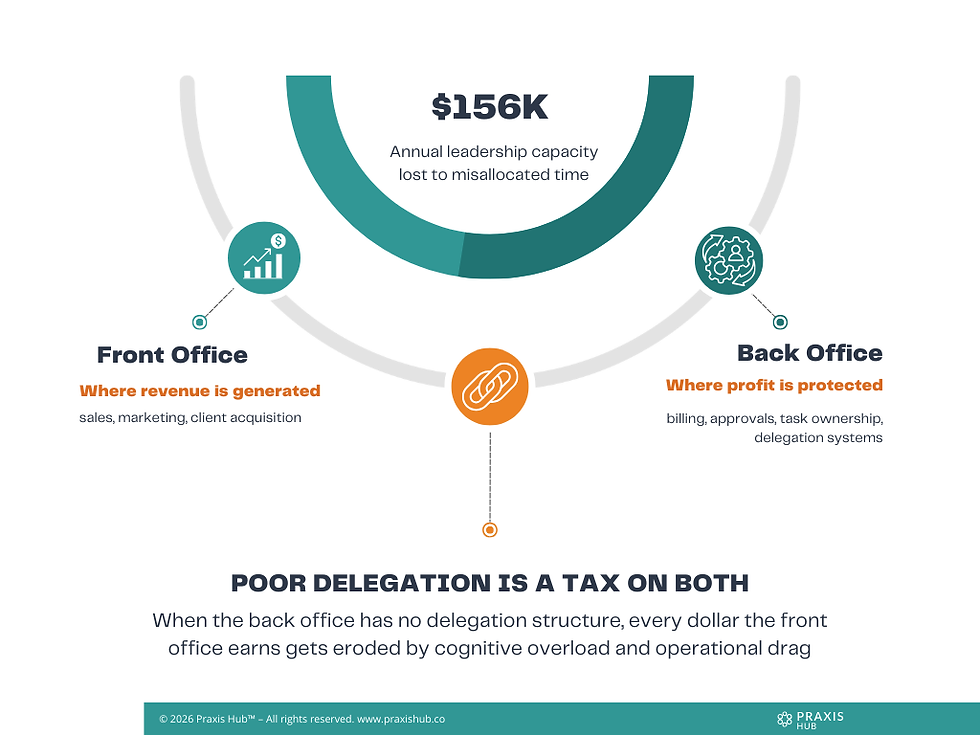
Every unresolved task, every pending approval, every problem waiting for your input takes up mental real estate. And that real estate has a financial cost: a proposal that sat for a week because you were buried in approvals, a client follow-up that slipped because nobody else had authority to respond, a hiring decision delayed so long the best candidate took another offer. A leaky back office is a tax on every dollar the front office earns.
According to DDI's Global Leadership Forecast 2025, 71% of the 10,700 leaders studied report significantly higher stress since stepping into their current roles. Nearly one in six is experiencing burnout, and 40% of stressed leaders have considered stepping away entirely. In a growing business with 10 to 50 employees, where the owner is the only senior leader, those numbers are likely worse.
Why Delegation Fails at the Structural Level
Here is the pattern that shows up across industries: a business owner knows they need to delegate. They have a team. They have the intention. But delegation does not stick.
Most businesses were built around speed and survival. The owner made the decisions because they were the fastest path to getting things done. That was rational. But the structure that supported early growth becomes the bottleneck at the next stage.
Delegation fails when there is no system underneath it. No documented process. No defined ownership. No accountability loop. Without those elements, delegation becomes a handoff into a void, and the work bounces back to the owner within days.
The financial impact of that bounce-back is measurable. If a business owner earning $2M in revenue spends 15 hours per week on tasks that should be delegated, and their effective hourly value is $200, that is $156,000 per year in misallocated leadership capacity. That number does not appear as a line item, but it shows up in missed growth, slower collections, and strategic decisions that never get the attention they deserve.
DDI's assessment of more than 70,000 manager candidates found that only 19% demonstrate strong delegation abilities. Their research also found delegation is the single most effective skill for preventing burnout, with five times the impact of any other method. This is not a willpower problem. It is a systems problem.
Decision Fatigue: The Silent Tax on Leadership
According to the American Medical Association, decision fatigue is the measurable decline in decision-making quality that occurs after a person makes repeated choices throughout the day. The more decisions you make, the more your cognitive resources deplete, leading to poorer judgment, avoidance, or impulsive shortcuts.
For a business owner who is the operational bottleneck, strategic decisions that drive growth compete with dozens of low-value approvals for the same limited bandwidth. The owner's time, valued at $200 per hour, gets spent on $20 per hour decisions. The team waits. Billable hours stall. Revenue that could have closed this quarter gets pushed to next.
Consider this: if a broken approval process adds five days to your average invoicing cycle, and your monthly billing is $150,000, you are carrying an additional $25,000 in receivables at any given time. That is not a process inefficiency. That is a cash flow problem caused by a delegation gap the owner may not even recognize.
DDI's forecast data shows only 30% of leaders feel they have sufficient time to do their job well. For small business owners who wear multiple hats, that scarcity compounds daily.
What Changes When the Weight Lifts
When a business owner recovers 15 hours per week, that time goes back into closing deals, building relationships, and making the decisions that actually move the business forward.
But the shift business owners notice first is not financial. It is psychological. When clear delegation paths exist and a team can operate without routing every question through one person, the leader gets back the ability to think strategically instead of reactively.
Gallup's research confirms that managers account for up to 70% of the variance in team engagement. When the leader is depleted, the team feels it. When the leader regains capacity, it shows up in faster execution, lower turnover costs, and stronger client retention.
Freeing 30% of a leader's time does not require hiring more people. It requires building the structural foundation that makes delegation work: clear processes, defined ownership, and accountability systems that hold without the owner's constant oversight.
Why Outside Perspective Helps
The person who needs to build the delegation structure is the same person buried under the weight of not having one. This is a proximity issue, not a competence issue. When you built the business and live inside its operations every day, the bottleneck feels normal because it has been normal for years.
In my experience across different industries, the leaders who struggle most with delegation are often the most capable operators. The business was never structurally designed to run without them, and redesigning that structure while carrying the full operational load is nearly impossible alone. The solution is a structural redesign of how work flows, who owns what, and where the leader's time should actually go.
Free Resource: CEO Time Audit
The CEO Time Audit tracks where your hours go each week and calculates how much of your time is spent on tasks that should belong to someone else. Most business owners who complete it discover 30 to 40 percent of their week could be delegated with the right structure. At $200 per hour of leadership value, that is $150,000 or more in annual capacity being absorbed by the back office instead of directed toward growth.
Get the CEO Time Audit — See where your hours are actually going.

Frequently Asked Questions
Why does delegation fail even when the team is capable?
Missing structure, not missing talent. Without documented processes, clear ownership, and accountability systems, even a skilled team defaults to asking the leader. The fix is structural: build systems that allow the handoff to hold.
Is decision fatigue a real problem for small business owners?
Every decision draws from the same limited cognitive resource pool. For business owners making dozens of operational and strategic decisions daily, decision quality drops by mid-afternoon. This affects hiring choices, client relationships, and long-term planning.
How much time can delegation actually free up?
In most growing businesses with 10 or more employees, structured delegation can recover 10 to 20 hours per week. At $200 per hour of leadership value, that represents $100,000 to $200,000 in annual capacity redirected back to strategic work.
Does fixing delegation require hiring additional people?
Not necessarily. Most teams have underutilized capacity because the delegation paths do not exist. Work bounces back to the owner not because nobody else can do it, but because nobody else has clear ownership or decision-making authority.
What is the difference between delegation and just assigning tasks?
Assigning a task transfers the work. Delegation transfers the ownership. When delegation works, the team member owns the outcome and has authority to make decisions within defined boundaries.
Ready to Reclaim Your Time?
The CEO Time Audit shows you where your hours are going in 15 minutes and identifies exactly where delegation could recover capacity and reduce the financial drag on your business.
Sources Referenced:
The Back Office Brief
Get a weekly insight connecting back office operations to profit. Delivered every week, free.



Comments