
Why Delegated Work Comes Back: The Process Gap Nobody Talks About

You handed it off. You explained it. You even walked them through it once. And yet, here it is again, sitting in your inbox, waiting for you to finish what someone else was supposed to own.
This pattern has a name in operations: the boomerang effect. And according to a McKinsey Global Survey, managers spend nearly half their time on nonmanagerial work, with less than a third going to talent and people management. That is not a time management problem. That is a process problem with a dollar amount attached.
Table of Contents
The Boomerang Effect: When Tasks Return to the Leader
Here is what I have noticed across different industries. A business owner delegates a task. The team member starts it, gets stuck, and brings it back. The owner finishes it because it is faster than explaining the issue. Over time, this becomes the default: the owner is the backup plan for every incomplete task in the business.
The question is not whether the team is capable. The real question is: why delegated work comes back. And the answer is that a work system does not exist yet. Without documented steps, defined ownership, and a clear standard for "done," every delegated task becomes a question mark. And question marks always travel upward.
Not sure where your hours are actually going? The CEO Time Audit is free and takes 15 minutes. It shows you exactly where your time is spent and where it is being wasted.
Why Delegated Work Comes Back: Three Operational Patterns
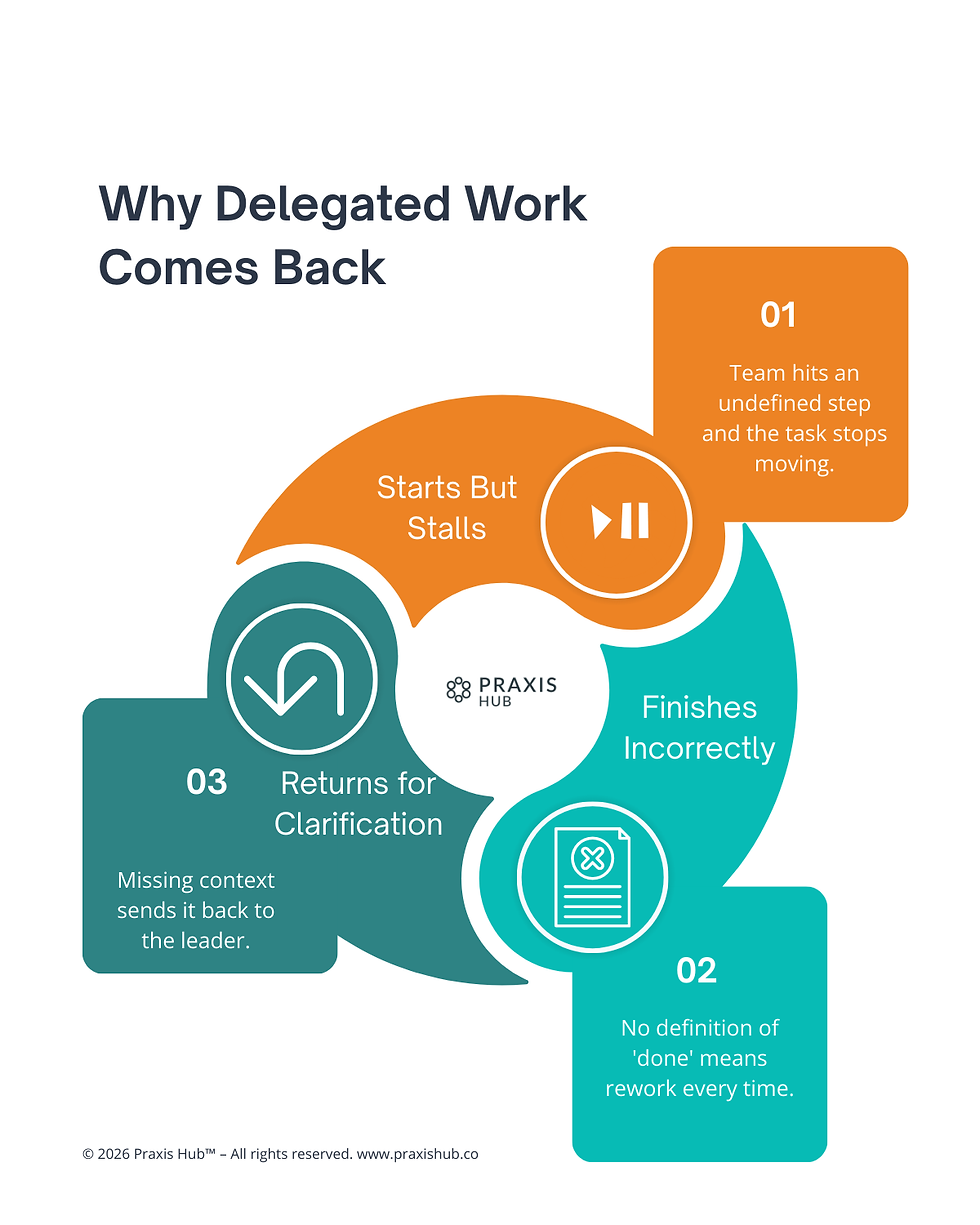
When processes are missing, work becomes memory based. The steps live in one person's head, usually the owner's, and everyone else operates on best guesses. This creates three predictable patterns that show up in nearly every growing company.
Work starts but does not finish. The team member begins the task, hits an undefined step, and stalls. There is no documentation to reference and no one else to ask. The task sits incomplete until the owner intervenes.
Work finishes but incorrectly. Without a clear definition of what "done" looks like, the team member delivers something that does not meet expectations. The owner reworks it, often spending more time on corrections than the original task would have taken.
Work returns for clarification. The instructions were incomplete. The team member needs approval, a decision, or context that was never built into the process. The task comes back, and the owner becomes the bottleneck again.
None of these patterns are caused by a lack of effort. The people doing the work are trying. The system around them is not giving them what they need to succeed independently.
The 30 Percent Rule: Work That Should Never Reach You
Across different industries, a consistent pattern emerges: roughly 30 percent of a leader's workload consists of tasks that are repeatable, low judgment, and predictable. These tasks do not require the owner's expertise. They require a documented process and someone trained to follow it.
The list is usually shorter than people expect: scheduling, routine client updates, reporting preparation, follow ups, and billing preparation. These tasks happen on a regular cycle. They have defined inputs and outputs. They do not change significantly week to week.
When these tasks stay on the owner's plate, it is not because the team is incapable. It is because the handoff was never built. There is no written process, no training material, and no accountability structure to support someone else doing the work consistently.
The Gallup State of the Global Workplace 2025 report found that 70% of team engagement is attributable to the manager. When the manager is buried in tasks that should be handled by others, the entire team's performance suffers. The manager cannot coach, develop, or lead because they are too busy doing work that belongs somewhere else in the organization.
The Financial Cost of Work Without a System
Revenue comes from the front office. Profit is protected in the back office. When back office processes are undefined, every dollar the front office generates gets taxed by inefficiency on the back side.
Here is what that looks like in practice. An owner earning the equivalent of $200 per hour spends three hours a day on $20 per hour work: confirming appointments, re-explaining processes, reviewing tasks that should have been right the first time. That is $600 a day in misallocated leadership time. Over a year, that number approaches $150,000 in time that could have been directed toward growth, strategy, or business development.
The cost is not just the owner's time. It is the revenue that was never generated, the team that never developed, and the customer experience that suffered because nobody owned the follow up.
A leaky back office is a tax on every dollar the front office earns. And the leak does not stop until someone builds the system that closes it.

Why Outside Perspective Changes the Pattern
When you are inside operations every day, these patterns become invisible. It is not a failure of intelligence. It is a structural limitation. You cannot see what is broken in a system you built and live inside every day.
This is a proximity issue, not a competence issue. The owner built the business. The owner knows the work better than anyone. That depth of knowledge is exactly what makes it difficult to step back and see where the process gaps are creating unnecessary dependency.
In my experience, business owners know something is wrong. They feel it in the 60 hour weeks, the constant interruptions, the inability to take a vacation without the business slowing down. What they often cannot identify is the specific structural gap causing it.
That is where outside perspective becomes valuable: not to replace the owner's judgment, but to map the systems that would allow the team to operate independently.
Most business advice lives in the front office. Praxis Hub works in the back office, where profit is actually protected.
Free Resource: CEO Time Audit
If tasks keep coming back to you, the first step is understanding exactly where your time is going. The CEO Time Audit is a free tool that tracks your weekly hours and identifies which tasks are draining your schedule. It shows the repeatable, low judgment work that should be documented and handed off, so you can start reclaiming time for the work only you can do.
Get the CEO Time Audit - See where your business stands
Frequently Asked Questions
Why does delegated work come back to the business owner?
Delegated work comes back when the process behind it is incomplete. If the steps are unclear, the definition of "done" is missing, or there is no documentation to reference, tasks will stall and return to the person who assigned them. Building a repeatable process with defined ownership and written standards eliminates the cycle.
How much time do leaders spend on tasks someone else could handle?
A McKinsey Global Survey found that managers spend nearly half their time on nonmanagerial work, including administrative tasks and individual contributor work that does not require their leadership. For business owners in smaller companies, that percentage is often higher because they also absorb unfinished work from the team.
What types of tasks should a business owner stop doing?
Tasks that are repeatable, low judgment, and predictable are the first candidates: scheduling, routine client updates, reporting preparation, billing preparation, and standard follow ups. These tasks happen on a regular cycle and do not require the owner's unique expertise.
What is the 30 percent rule in delegation?
The 30 percent rule is an operational observation: roughly 30 percent of a leader's weekly workload consists of tasks that do not require their judgment or expertise. Identifying and documenting these tasks creates the foundation for sustainable delegation, freeing the owner to direct attention to growth and strategic decisions.
How does undefined process affect a team's ability to execute?
When processes are undefined, teams operate from memory instead of systems. Instructions change from one instance to the next. "Done" looks different every time. Ownership is unclear. The result is inconsistency, errors, and a constant need for managerial intervention. Gallup research shows that 70% of team engagement depends on the manager, and managers buried in operational tasks cannot effectively lead or develop their people.
Ready to Stop Doing Work That Should Not Be on Your Plate?
The CEO Time Audit takes 15 minutes. It shows you exactly where your hours are going, which tasks are repeatable and ready to hand off, and where your time is being consumed by work the team could own with the right systems.
Get the CEO Time Audit - Start reclaiming your time
Book a Discovery Call - Talk about what is keeping you stuck
Sources Referenced:
The Back Office Brief
Get a weekly insight connecting back office operations to profit. Delivered every week, free.



Comments