
Repeatable Business Processes: The Discipline Most Growing Companies Skip

You have a business that produces real results. The work gets done. Clients are served. Revenue comes in. But the results shift depending on who is doing the work, what day it is, or whether the right person happened to be available, and somewhere in the back of your mind, you know that is not a system. That is a team of capable people carrying information that should live in the business itself.
In 1954, a 52-year-old milkshake machine salesman named Ray Kroc walked into a hamburger stand in San Bernardino, California. The McDonald brothers had already built something worth studying: eight items, assembly-line cooking, food in 30 seconds. Simple. Consistent. Profitable. Kroc did not improve the recipe. He built repeatable business processes around what already worked and opened the same exact store more than 7,500 times.
What Kroc Actually Built
When Ray Kroc walked into the McDonald brothers' hamburger stand in San Bernardino in 1954, he did not find a great restaurant. He found a great system. Eight items. Assembly-line cooking. Food in 30 seconds. The brothers had already done the hard work of figuring out what worked. Kroc's contribution was the discipline to refuse to touch it.
Competitors added pizza. He kept selling hamburgers. Health food trends arrived. He kept selling hamburgers. Franchise owners lobbied for local specialties -- lobster rolls in Maine, tacos in Texas. His answer was no. Board members showed him market research demanding variety. He ignored it. The result was a new store opening every 17 hours, running the same kitchen, the same menu, the same golden arches.
The lesson is not that McDonald's was stubborn. The lesson is that Kroc had enough confidence in the system to protect it from well-intentioned interference. That is a different discipline entirely and a rare one.
After Kroc died in 1984, McDonald's spent decades doing what everyone had been asking Kroc to do: adding salads, wraps, gourmet coffee, hundreds of menu items. Growth slowed. Complexity soared. The turnaround strategy introduced in 2015 was to strip the menu back to core items and reduce operational complexity. The company that abandoned its repeatable system spent years and significant capital trying to find its way back to it. Greatness is just good, repeated. The hard part is never finding the good thing. The hard part is having the discipline to keep running it.
The Complexity Trap
Growing businesses face the same pressure Kroc resisted, and most of them give in. A new client has a special request, so an exception gets made. A team member develops a workaround nobody writes down. A process that worked well at ten employees gets improvised at twenty. Each individual decision seems reasonable. Collectively, they erode the system.
This is not a failure of intention. It is what happens when growth moves faster than structure. The business is adding revenue on the front end while the back end absorbs an increasing load of variation, exception, and informal workaround. What looks like momentum is complexity accumulating quietly.
The financial consequence of this is visible on the income statement, but it rarely gets labeled correctly. Rework costs money. Inconsistent delivery costs money. Training new employees on a process that exists differently in every team member's head costs money. None of those line items say complexity tax. But that is what they are.
When a System Is Not Actually a System
Here is what I observe consistently across industries and company sizes: most businesses that believe they have a system actually have a habit. The distinction matters.
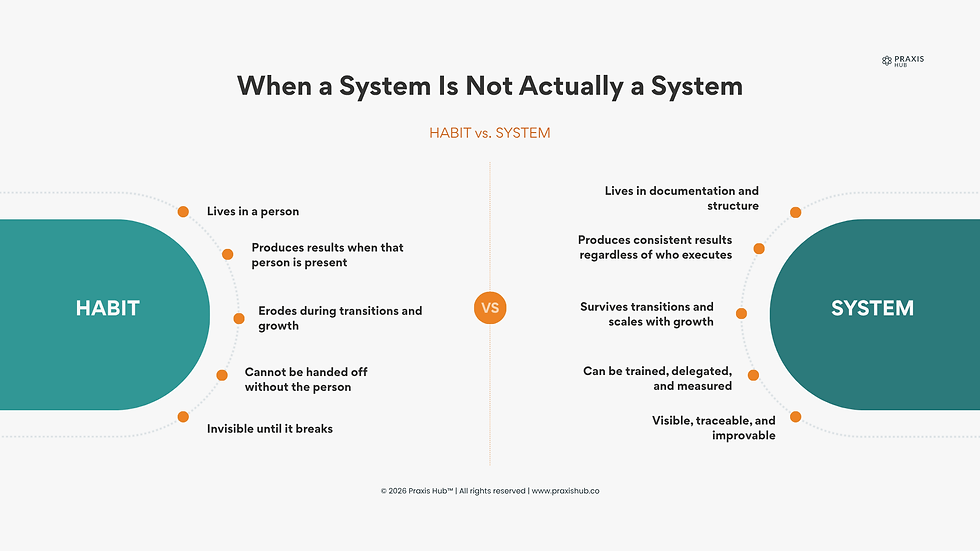
A habit is how a capable person performs a task when they know what they are doing. A system is how the task gets done reliably regardless of who is doing it, on what day, under what conditions. Habits live in people. Systems live in documentation, structure, and process design.
When the capable person is present, habits produce good results. When they leave, get sick, have a bad week, or simply cannot be everywhere at once, the habit evaporates and the result goes with it. This is why growth often degrades performance instead of improving it. The business is scaling the habit, not the system.
The McDonald brothers built a system. Kroc scaled it. The distinction is not semantic -- it is the entire explanation for why that particular business became worth more than General Motors while operating a menu that food critics called boring.
The difference between a business running on habit and one running on documented systems shows up in a specific set of observable patterns. What I see consistently in businesses that have built genuine repeatable processes:
New team members reach consistent performance without depending on a single person to train them
Problems get traced to where they entered the workflow rather than surfacing as general breakdowns
Performance is measured against a documented baseline rather than against memory or expectation
Institutional knowledge stays in the business when key people leave, not just in their heads
Growth adds volume without adding proportional confusion
None of those outcomes are accidental. They are the result of a deliberate choice to build systems instead of relying on capable individuals indefinitely.
What Repeatable Business Processes Protect on the Income Statement
Revenue comes from the front office. Profit is protected in the back office.

This matters because consistency is not just an operational virtue, it is a financial one. When processes are repeatable, the cost to deliver a unit of work stays predictable. When they are not, that cost floats. It absorbs the time spent figuring out how to do the work again, the errors from inconsistent methods, and the rework that follows.
These costs show up in a few predictable places on the income statement. Gross margin absorbs the labor and time inefficiency of inconsistent delivery. Operating expenses absorb the overhead of duplicate effort, informal communication, and decisions that required escalation because no one had a process to follow. The owner's time absorbs the interruptions and approvals that a documented system would have handled without involvement.
What a documented, repeatable process protects is the margin between what the business earns and what it actually keeps. That gap widens or narrows based on how consistently the back office can execute without creating new costs in the process of doing its work.
Why Outside Perspective Helps
Proximity to your own business makes it difficult to see which processes are actually repeatable and which ones only appear to be because the same people have always run them. When a capable team member handles something seamlessly, it is easy to assume the process is solid. The test is not what happens when they are there. The test is what happens when they are not.
This is not a reflection on the team or the owner. It is a structural reality. The habits that carry an early-stage business forward become invisible to the people who built them. Undocumented informal practices that would not survive a team change, a growth phase, or a disruption.
An outside perspective identifies the difference between a process that is documented and repeatable and one that is simply familiar. That distinction determines whether the business is building something scalable or something that depends on specific people to function.

Free Resource: System Leak Audit
If the question this post raised is whether what your business is running is actually repeatable, or whether it is running on habit, memory, and the institutional knowledge of a few key people. The System Leak Audit is the right starting point. It is a free, 15-minute diagnostic that identifies the five categories of back office gaps most likely to be costing you money right now.
Ready to Talk About What Your Business Is Actually Running On?
If this post raised questions about the gap between the processes your business has and the processes it needs, that is worth a direct conversation. A discovery call is where we look at what your back office is currently doing and whether it is structured to hold the growth you are building toward.
Frequently Asked Questions
What are repeatable business processes and why do they matter?
Documented, consistent workflows that produce the same result regardless of who is performing them or when are the foundation of a scalable back office. They matter because consistency is what protects margin. When a process produces a different result depending on the person or the day, the business absorbs that variation as cost -- in rework, in oversight, in the owner's time spent correcting what a documented system would have handled. The difference between a business that scales well and one that hits a ceiling is often this: one has processes the business owns, and one has habits that key people carry.
How do I know if my business has real systems or just habits?
The test is not how the work runs when experienced people are present. The test is what happens when they are not. If a capable team member is out for a week and their work either stops or degrades significantly, that is a habit. If another person can follow documentation and produce the same result, that is a system. Most growing businesses discover through team transitions or growth phases that what they thought were systems were actually undocumented habits that only appeared reliable because the same people had been running them for years.
What is the financial cost of inconsistent business processes?
Inconsistent processes create costs that rarely get labeled as process failures on the income statement. Gross margin absorbs labor inefficiency when work takes longer than it should because the team is figuring out how to do it rather than executing a defined method. Operating expenses absorb duplicate effort, informal coordination, and decisions that required escalation. The owner's time absorbs interruptions and approvals that a documented process would have handled independently. These costs are real and recurring, but because they are diffuse rather than concentrated, they tend to be attributed to staffing, communication, or growth pains rather than to the absence of structure.
Can a small business with a good team afford to skip process documentation?
A good team performing consistently can mask the absence of documented processes for a significant period. The risk surfaces when that team changes. Every departure, every new hire, every growth phase exposes what was never written down. The businesses that invest in documentation before they need it preserve the institutional knowledge their capable people carry. The businesses that wait until after a key departure typically spend significant time and money reconstructing what should have been captured. Process documentation is not about not trusting the team. It is about not building the business entirely on their continued presence.
What is the connection between repeatable processes and business scalability?
A business scales when it can produce more output without proportionally increasing the owner's involvement or the cost to deliver. That is only possible when the processes driving delivery are documented well enough to be handed off, trained on, and executed consistently by people who were not there when the methods were first developed. What Kroc understood about the McDonald brothers' system is what applies to any business trying to grow: you cannot scale a habit. You can only scale a system. The question every business owner should be asking before they pursue growth is whether what they are running is ready to be run at a larger scale, or whether it will simply break more expensively under pressure.
The Back Office Brief
Get a weekly insight connecting back office operations to profit. Delivered every week, free.



Comments