
Deepfake Fraud Prevention: The Operational Gap That Puts Your Business at Risk

The call came from the CEO. The voice was familiar. The request was urgent. And over a million dollars disappeared before anyone realized it was a fraud.
According to the FBI's 2024 Internet Crime Report, cybercrime losses in the United States reached $16.6 billion last year, up 33%. Business email compromise alone accounted for $2.77 billion. Deepfake fraud is no longer reserved for Fortune 500 companies. It is showing up in growing businesses that assume they are too small to be targeted. And when it hits, it exposes every back office weakness the business never documented.
Table of Contents
When Trust Becomes the Vulnerability
Here is a pattern I have seen more than once in my experience across different industries. A phone call comes in to a business unit. The voice on the other end sounds like the CEO. The request is urgent: a deal needs to close, and a cash transfer is required immediately. The employees who receive the call are experienced, diligent, and known for following guidance.
Here is what makes this pattern so dangerous: the company had approval processes in place. Payment thresholds existed. Two authorized people were required to sign off on transfers above a certain amount. The team followed all of it. Both approvers reviewed the request and authorized the payment, exactly as the process required.
They processed the first transfer. A few weeks later, a second request came through the same channel. By the time the fraud was identified, the total exceeded a million dollars. Law enforcement got involved and recovered a portion of the funds, but the money had already moved overseas. The employees who followed every documented step lost their jobs.
The controls were there. The approvals were there. What was missing was one protocol: what do you do when the CEO calls and asks for money? There was no process for verifying the identity of the person making the request. No callback to a known number. No confirmation through a different channel. The approval thresholds caught the amount. Nothing caught the impersonation.
That is what makes deepfake fraud fundamentally different from other business risks. It does not exploit missing controls. It finds the one gap your existing controls do not cover. And when that gap sits at the top of the chain of command, the people who followed every rule pay the price.
The Scale of Deepfake Fraud in 2026
The Deloitte Center for Financial Services projects that generative AI could drive U.S. fraud losses to $40 billion by 2027, up from $12.3 billion in 2023. Voice cloning, face-swap video tools, and AI-generated documents are now commercially available and cheap to deploy.
The ACFE's Fraud Magazine traced deepfake attacks through three cases: a 2019 voice clone targeting a U.K. energy firm, a 2024 video conference scam that cost Arup $25.6 million, and a 2025 series of AI voice impersonations targeting Italy's business leaders.
Experian's 2026 Future of Fraud Forecast confirms the threat extends beyond financial transfers, with deepfakes infiltrating remote hiring processes and gaining access to systems through fabricated identities.
For growing businesses, these numbers represent something specific. Every dollar lost to deepfake fraud is a dollar the front office earned that the back office failed to protect. Revenue comes from the front office. Profit is protected in the back office. When back office controls have blind spots, the front office is working for the fraudsters without knowing it.

Why Growing Businesses Are Especially Vulnerable
Here is the pattern I see across different industries: many companies have financial controls in place. Payment thresholds, approval chains, authorization limits. But those controls almost always assume that the person initiating the request is who they say they are. That assumption is exactly what deepfake fraud targets.
The ACFE noted that in the Arup fraud, the employee who authorized $25.6 million reportedly had power to approve large sums without additional oversight. But even in organizations with dual authorization, the gap lives in the same place: no protocol for verifying the identity of the person giving the instruction. When the CEO calls and says move the money, the approval process catches the amount. Nobody verifies the CEO is actually the CEO.
In growing businesses with 20 to 300 employees, this gap is compounded. The owner delegates payment authority as the company scales, but the identity verification layer was never formalized. The back office grew to match revenue, but the controls did not grow to match the risk.
And that gap has a number attached to it. In the pattern I described, every control worked as designed. Two authorized people approved the transfer. The threshold process was followed. The total still exceeded a million dollars. The employees who followed every step lost their careers. The controls caught the amount. Nothing caught the voice on the other end of the phone.
The Financial Cost of Missing Back Office Controls
Most business leaders think about fraud as something that happens to other companies. But the financial impact goes beyond the money lost.
When a deepfake fraud hits, the secondary costs are where the real damage compounds. Legal fees. Insurance premium increases. Executive time spent managing the crisis instead of running the business. And if the fraud damages client trust, the revenue impact on the front office can far exceed the original loss.
A leaky back office is a tax on every dollar the front office earns. Slow invoicing delays cash flow. Informal approval chains lead to costly errors. Deepfake fraud simply makes the cost of those gaps catastrophic instead of gradual.
The back office does not show up on your marketing dashboard. It shows up on your income statement. When the controls have blind spots, the income statement tells the story before leadership sees it coming.
Deepfake Fraud Prevention: Where the Real Gap Lives
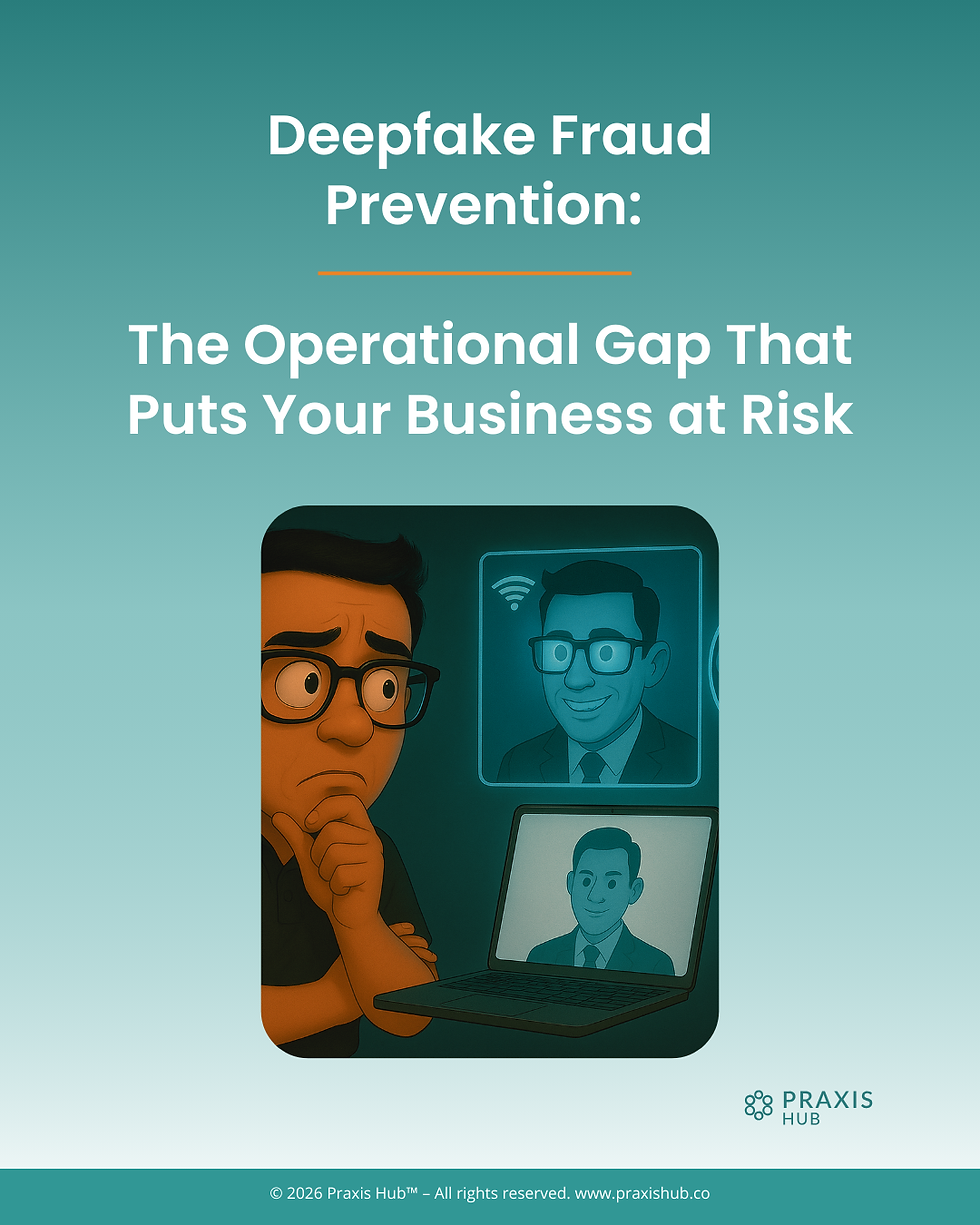
Most conversations about deepfake fraud prevention center on technology: AI detection software, biometric authentication, liveness verification tools. Those matter. But they solve the last 10% of the problem.
The first 90% is operational. It lives in your back office. And it is not about whether you have approval processes. Most businesses do. The gap is whether your processes verify the identity of the person making the request, not just the amount being requested. If someone calls claiming to be the CEO and requests an urgent transfer, does your protocol require verifying that voice through a separate channel before the approval process even begins? For most growing businesses, that protocol does not exist.
That is not a technology gap. It is a process gap. The fraudsters in the pattern I described did not hack a system or bypass the approval thresholds. They impersonated the one person whose requests nobody questions, and the entire control structure activated in their favor.
And here is the part that connects directly to profitability: every dollar that moves through a process where identity is assumed rather than verified is a dollar at risk. Deepfake fraud prevention is the same back office discipline that protects margins, reduces rework, and gives leadership accurate financial data to make decisions.
You cannot automate a broken process. You can only break it faster. And you cannot protect revenue when the person giving the order is never verified.
What Verification Looks Like at the Process Level
Preventing this kind of fraud at the operational level is not complicated. It is specific. And it needs to be documented before a crisis, not during one. The key insight: approval thresholds and dual authorization are necessary, but they are not sufficient. Identity verification is the layer that most back office controls are missing.
Identity verification protocol for executive requests. When any request for a financial transaction comes from a senior leader, the process must require verification of that person's identity through a separate, pre-established channel before the approval process activates. In the pattern I described, the approval process worked perfectly. What was missing was the step before the approval: confirming the voice on the phone was real.
Callback verification on payment changes. If a vendor, executive, or partner requests a change to banking details, your team calls back on a previously verified number, not the number provided in the new request.
Documented escalation procedures. When a request feels urgent or unusual, your team needs a written path to escalate. Without it, employees comply with fraudulent requests because they do not want to delay a CEO's deal. A documented process gives them permission to verify.
Periodic process review. A verification process written two years ago may not account for current AI sophistication. The ACFE emphasizes that organizations must regularly test and update these protocols.
None of this requires new software. It requires one additional layer in your existing process: verify the person, not just the amount. Every one of these controls does double duty: it prevents fraud and strengthens the back office infrastructure that protects profitability.
Why Outside Perspective Helps
When you built your business, you built the processes around the way you work. That is natural. But it means you are too close to see where the blind spots are. The approval workflows, the trust chains, the identity assumptions: these become invisible when you live inside them every day.
This is not a competence issue. It is a proximity issue. You cannot see what is broken in a system you built and live inside every day. The vulnerabilities in back office controls only become visible when someone with an outside perspective maps the workflows, identifies the exposure points, and documents what the verification process should look like at your current scale.
In my experience across different industries, the businesses most vulnerable to deepfake fraud are not the ones with bad teams. They are the ones that grew fast and never went back to formalize the controls that protect what they built. The front office kept selling. The back office never caught up.
Free Resource: Crisis Control Checklist
If a deepfake fraud attempt happened tomorrow, would your team know what to do? The Crisis Control Checklist provides a 5-step emergency framework to help you respond when things go wrong, whether the crisis is fraud, a system failure, or an operational breakdown.
Get the Crisis Control Checklist - See where your business stands
Frequently Asked Questions
What is deepfake fraud and how does it target businesses?
Deepfake fraud uses artificial intelligence to clone voices, generate realistic video, or fabricate identities to impersonate trusted individuals. Fraudsters typically impersonate executives or vendors to authorize payments or access sensitive systems. These attacks have evolved from simple voice cloning to real-time video conference impersonations.
Are small and mid-size businesses really at risk for deepfake attacks?
Yes. Growing businesses are often more vulnerable because even when they have approval processes, the identity verification layer is missing. A business where the CEO's voice on a phone call is enough to activate the approval chain is exactly the kind of target deepfake fraudsters seek out.
What is the most important step a growing business can take to prevent deepfake fraud?
Adding an identity verification layer to your existing approval process. Before the approval chain activates on any executive financial request, the identity of the person making the request must be confirmed through a separate, pre-established channel. This means calling back on a known number or verifying through a different communication method. Approval thresholds catch the amount. Identity verification catches the impersonation.
Does protecting your business from deepfakes require expensive technology?
Not at the foundational level. The most effective defense is adding an identity verification protocol to your existing approval process: callback procedures and confirmation through a separate channel before financial requests are approved. Technology adds additional layers, but the process infrastructure needs to come first.
How often should businesses review their fraud prevention processes?
At minimum, annually. Given the pace at which deepfake technology is advancing, a quarterly review of verification protocols is becoming the standard recommendation from organizations like the ACFE and Deloitte.

Ready to Identify the Gaps in Your Back Office?
You do not need to wait for a crisis to find out where your business is exposed. The Crisis Control Checklist helps you identify the operational gaps that deepfake fraud exploits.
Sources Referenced:
The Back Office Brief
Get a weekly insight connecting back office operations to profit. Delivered every week, free.



Comments