
Business Process Redesign for AI: Why the Back Office Decides What AI Returns

The tools are live. The budgets are approved. The demos went well.
And yet, most growing businesses are not seeing the returns they expected from AI. In my experience across different industries, that gap almost never traces back to the technology.
The Question Has Shifted
Six months ago, most business conversations about AI were still about which tool to buy. Which platform. Which model. Which vendor had the best demo.
That conversation has moved.
What I'm seeing now, and what the research confirms, is that companies are sitting with tools already deployed and results that don't match the investment. The question on the table is no longer which AI to use. It is which processes to redesign first, and why that sequence matters.
That is a back office question. Not a technology question.
Revenue comes from the front office. Profit is protected in the back office. AI does not change that equation. It amplifies it. When a business layers AI on top of processes that were never structured to begin with, the tool performs. The business does not. What gets amplified is the gap.
This is the part of the AI conversation that is not making it into most boardrooms yet.

What the Research Is Actually Saying
The data from 2026 tells a story worth reading carefully, especially if your business has already committed budget to AI tools.
According to Writer's 2026 Enterprise AI Adoption Survey, only 29% of organizations report significant ROI from AI, and 75% of executives admit their company's AI strategy is more for show than actual internal guidance. These are not fringe companies or early adopters who moved too fast. This is the broad middle of the market.
Deloitte's State of AI in the Enterprise 2026 adds the operational dimension. Only 25% of leaders report AI is having a transformative effect on their business. Workforce access to AI tools has grown to roughly 60% of workers — but fewer than 60% of those workers use the tools in their daily workflow. Access expanded. Behavior did not.
What both reports describe is a deployment problem, not a technology problem. The tools are available. The operational infrastructure to receive them is not.
This pattern shows up across industries, and it shows up at every stage of growth. The business that has 15 employees and just added an AI scheduling tool is living the same problem as the enterprise that just completed a six-figure implementation. Access to AI is not the same thing as readiness to extract value from it.
Where the Financial Consequence Lives
When AI is deployed into a business without prior process redesign, the financial consequence is quiet and gradual. It rarely announces itself clearly on the income statement. That is what makes it dangerous.
Here is what this typically looks like in practice.
A business automates its client intake process before documenting the handoff between intake and service delivery. The AI captures the information correctly. The handoff still breaks, the same way it always did, because the handoff was never part of the tool's scope. Rework accumulates. The team assumes the AI is the problem. The AI is not the problem.
Or a business deploys an AI tool for document review in its back office before defining who owns the approval step when the AI flags an exception. The document sits. The delay hits accounts receivable. The cash flow consequence is real and traceable, but no one connects it to a missing governance decision that should have been made before the tool went live.
This is where the back office absorbs the cost of a front-end decision. The tool was purchased. The operational design work was skipped. Revenue was unaffected. Profit took the hit.
If your business is not seeing AI ROI, the diagnosis almost certainly starts here.
Why AI Documents What You Describe and Misses What You Left Out

There is a specific blind spot in how most businesses approach AI implementation, and understanding it is the prerequisite to everything else.
AI documents what you describe. It produces clean, organized output from the inputs you give it. What it cannot do is see what you left out of the description, identify the handoff that breaks under pressure but not under normal conditions, or recognize the approval step that creates exposure in your specific operating environment.
The owner cannot audit this gap alone. Proximity is the structural reason, not any failure of knowledge or capability. When you have built the process and live inside it every day, the invisible parts of it are invisible to you by definition. That is not a solvable problem with more effort. It requires an outside perspective to close.
This is also why the answer is not a different AI tool. A better AI tool runs the same analysis on the same inputs. The inputs are the problem.
Business process redesign for AI is the work that happens before the tool is configured, not after it fails to deliver. It surfaces what the business actually does versus what the owner believes it does, identifies where the gaps are structural versus situational, and maps the downstream financial consequence of each gap before automation makes it permanent.
Visit praxishub.co/business-process-improvement to learn how this work is structured for growing businesses.
What Business Process Redesign for AI Actually Requires
This work is not a technology project. It does not start with the tool. It starts with the operating structure the tool will run inside.
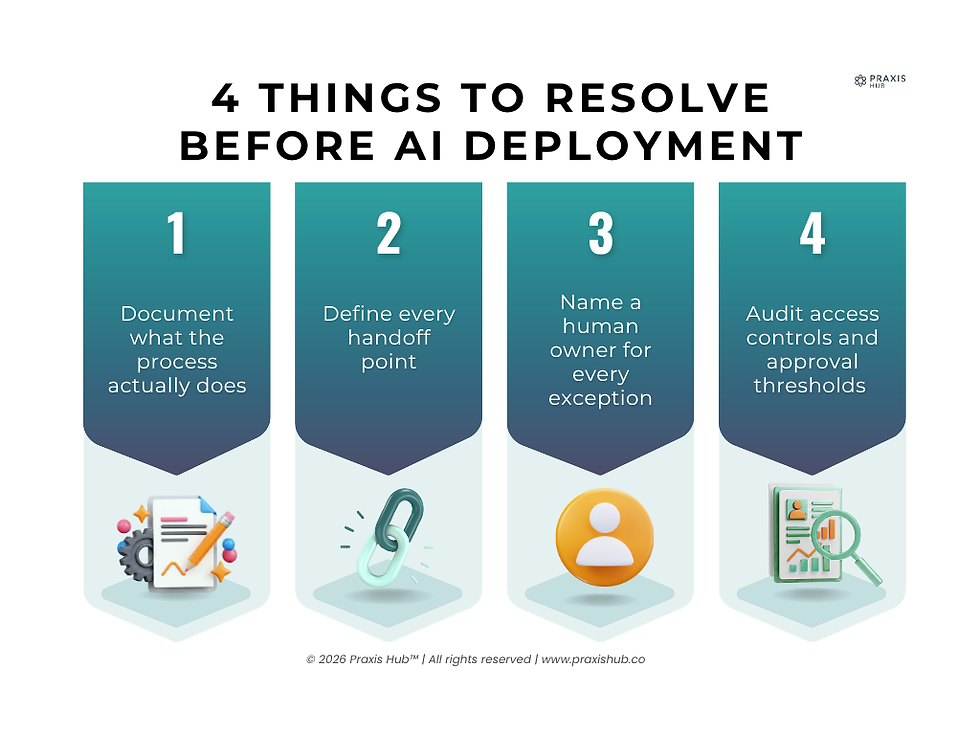
In my experience, the businesses that extract consistent value from AI share a common pattern: the operational structure was evaluated before the tool was configured. The gaps that undercut AI ROI are not random. They cluster around the same four failure points across industries and company sizes.
A process map that reflects what the business actually does, not what leadership believes it does. These two are almost never identical, and the distance between them is where most AI implementations quietly fail.
A defined handoff structure at every point where work passes between people, teams, or systems. AI does not create handoffs. It runs inside them. An undefined handoff does not get organized by automation. It gets accelerated.
A named human owner for every exception the tool will surface. AI handles the standard path. What breaks systems is the edge case, the flag, the thing the tool does not know how to route. If no one owns that decision, it sits. Sitting decisions carry a cost that lands in cash flow and accounts receivable.
A pre-implementation review of access controls, approval thresholds, and reconciliation cadence. Automation changes who can see what, and when. If these controls were not designed with that change in mind, the tool may close some exposure gaps while opening others.
None of this is the vendor's responsibility. None of it comes with the software. It is the operational work that sits between the purchase decision and the return on it.
If you are wondering whether your back office is structured to receive what your AI tools can give, the AI Readiness Assessment is a good starting point. It takes approximately 15 minutes and surfaces the operational gaps most likely to limit your results.
This connects directly to the pattern examined in the AI Cargo Cult Business post: the surface behavior of AI adoption without the substance of operational redesign. The financial consequence of skipping that redesign work is what this post is designed to help you prevent.
Ready to Talk About What Your Back Office Is Ready For?
If you have already deployed AI tools and the results are not matching the investment, the conversation worth having is not about the tool. It is about what the business handed the tool to work with.
Book a discovery call and let's look at where the operational design work needs to happen before the next phase of your AI investment.
Frequently Asked Questions
What is business process redesign for AI and why does it matter?
Business process redesign for AI is the work of restructuring how a business operates before or alongside AI tool deployment, so the operational environment is ready to receive and sustain the technology. It matters because AI amplifies what is already in place. A structured process becomes more efficient. An unstructured one becomes more expensive, faster.
Why are so many businesses not seeing ROI from AI?
According to the Writer 2026 Enterprise AI Adoption Survey, only 29% of organizations report significant AI ROI, and 75% of executives describe their AI strategy as more for show than substance. The primary reason is that most businesses deploy AI tools without redesigning the processes those tools run inside. The tool performs. The operating structure limits what it can return.
Can AI help me document my own business processes before redesign?
AI can document what you describe to it. The structural limitation is that it cannot identify what you left out, the handoffs that break under pressure, the approval gaps that create financial exposure, or the downstream risks that only become visible to someone who has seen the same pattern in other operating environments. Documentation is a commodity. The judgment layer underneath it is not.
What does business process redesign for AI look like in a growing business with 10 to 50 employees?
In a business of that size, redesign typically focuses on three areas: handoff points between people or systems where work regularly stalls, approval and exception processes that AI will surface but that no one owns the decision for, and access and reconciliation controls that were not designed with automation in mind. The work is operational and specific to the business, not a template applied generically.
How do I know if my business is ready for AI implementation?
Readiness is an operational question before it is a technology question. The businesses that extract consistent value from AI are the ones that have documented what their processes actually do, defined who owns exception decisions, and identified control gaps before the tool is configured. The AI Readiness Assessment at AIReadyPalmBeach.com is a free 15-minute starting point for identifying where your business stands on each of these dimensions.
The Back Office Brief
Get a weekly insight connecting back office operations to profit. Delivered every week, free.



Comments